
SHA-256 vs SHA-512: Hashing Differences and Use Cases
Learn how SHA-256 and SHA-512 differ, how hashes verify data integrity and why ordinary hashing is not sufficient for password storage.
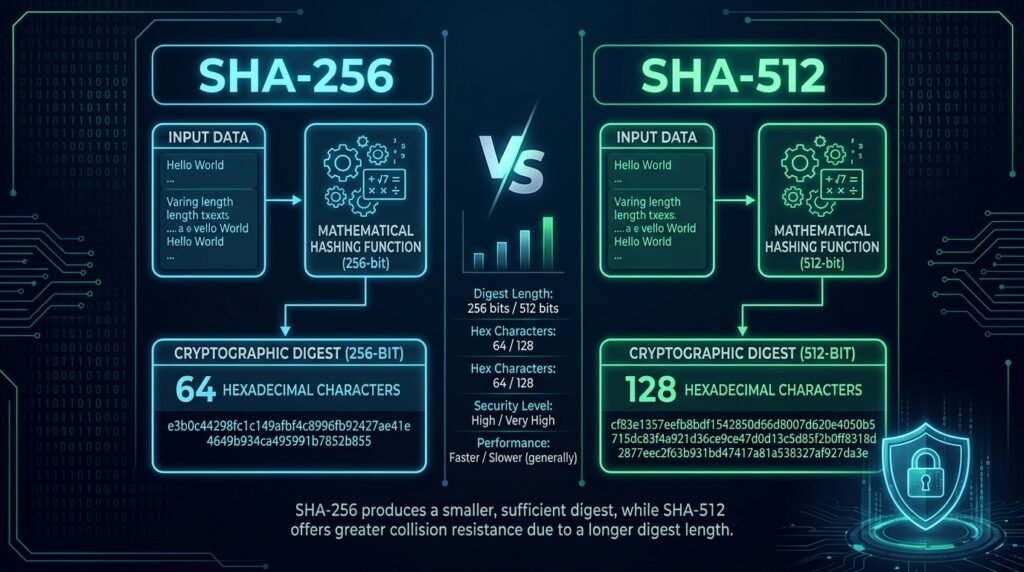
Modern cybersecurity, software distribution, and cloud storage rely on cryptographic hashing to verify data integrity and secure digital communications. When evaluating SHA-256 vs SHA-512, engineers must understand how these Secure Hash Algorithm 2 (SHA-2) family members transform variable-length inputs into fixed-length digests with distinct performance profiles.
Both algorithms operate as deterministic one-way mathematical transformations, yet their internal architectures diverge in word size, round count, block processing, and execution speed. Evaluating these hash functions allows software teams to select the appropriate cryptographic primitive for file verification, API signatures, content-addressable storage, or high-throughput network protocols.
You can calculate several SHA-family hashes instantly in your browser using EzzDo’s free Hash Generator. If you work with encoded binary payloads or distributed identifiers, pair your hashing workflow with our client-side Base64 Encoder/Decoder and UUID/GUID Generator.
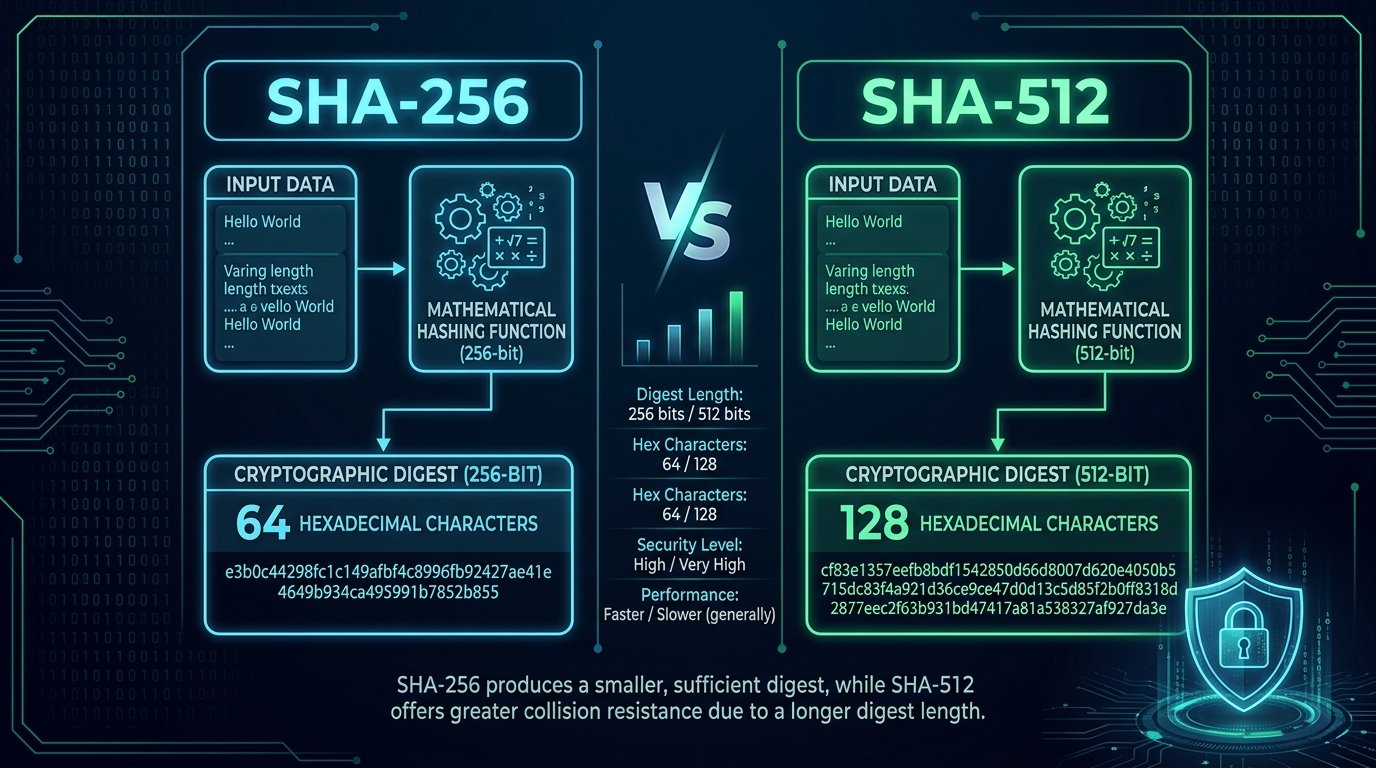
Table of Contents
SHA-256 vs SHA-512 at a Glance: Specifications and Anatomy
To establish a technical baseline for SHA-256 vs SHA-512, review the key algorithmic parameters established by NIST and internet engineering standards:
| Dimension | SHA-256 Property | SHA-512 Property | Impact |
|---|---|---|---|
| Digest Size | 256 bits (32 bytes) | 512 bits (64 bytes) | SHA-512 requires double storage space |
| Hex Length | 64 characters | 128 characters | String representation in logs and APIs |
| Word Size | 32 bits (4 bytes) | 64 bits (8 bytes) | SHA-512 aligns with 64-bit CPU registers |
| Block Size | 512 bits (64 bytes) | 1024 bits (128 bytes) | SHA-512 digests twice the data per cycle |
| Rounds | 64 compression rounds | 80 compression rounds | Higher mathematical mixing per block |
| Collision Security | 128 bits of security | 256 bits of security | Maximum birthday attack resistance |
| Pre-image Security | 256 bits of security | 512 bits of security | Resistance to brute-force inversion |
| Standard | FIPS PUB 180-4 | FIPS PUB 180-4 | Federal Information Processing Standard |
As documented in NIST FIPS 180-4 Secure Hash Standard and standardized in RFC 6234, comparing cryptographic parameters illustrates how mathematical structure shapes hardware performance.
What Is a Cryptographic Hash Function?
A hash function accepts arbitrary binary input, from short strings like EzzDo to multi-gigabyte disk images, and produces a fixed-length output known as a message digest. When examining SHA-256 vs SHA-512, both algorithms enforce four core mathematical properties:
- Deterministic: The same input produces the exact same output digest every time across all platforms.
- Avalanche Effect: A tiny input change produces a radically different digest across more than half of the bits.
- Pre-Image Resistance: The original input cannot practically be reconstructed from the digest alone.
- Collision Resistance: Finding two distinct inputs with identical digests is computationally infeasible.
These mathematical qualities ensure that studying SHA-256 vs SHA-512 provides developers with reliable building blocks for data integrity and authentication.
Cryptographic Hashing vs Encryption vs Base64 Encoding
Engineers often confuse hashing with encryption and encoding. Hashing is a permanent, one-way mathematical transformation designed for verification rather than confidentiality. In contrast, encryption is a two-way operation designed to be reversed using a matching secret decryption key. Encoding schemes such as Base64 merely convert binary data into printable ASCII characters for transmission across text channels.
For a detailed analysis of reversible data transport, read our guide on Base64 Encoding vs URL Encoding. Distinguishing reversible encoding from one-way transformations is essential when evaluating SHA-256 vs SHA-512 in production architectures.
Understanding these differences prevents architectural mistakes when selecting SHA-256 vs SHA-512 for system security.
SHA-256 Output Length and Architectural Applications
SHA-256 creates a 256-bit digest. When displayed in hexadecimal form, the result contains exactly 64 characters:
Input:  EzzDo
Digest: e3b0c44298fc1c149afbf4c8996fb92427ae41e4649b934ca495991b7852b855
Format: 64 hexadecimal characters (256 bits / 32 bytes)
Because 64 hexadecimal characters represent a compact footprint while offering 128 bits of collision resistance, SHA-256 has become the global standard for security infrastructure. Comparing SHA-256 vs SHA-512 reveals why SHA-256 is widely used for:
- File-Integrity Checks: Verifying downloaded software packages and operating system ISO distributions.
- Digital Signatures: Securing TLS and SSL certificates, X.509 chains, and DKIM email headers.
- Certificates: Signing public certificate authorities and authenticating web server domains.
- Content-Addressed Storage: Identifying immutable data chunks in IPFS and distributed object stores.
- Blockchain Systems: Powering Bitcoin proof-of-work mining algorithms and Merkle tree block hashing.
- Verifying Downloaded Data: Ensuring software release archives have not suffered bit corruption during transit.
In relational databases, 32-byte binary values fit into BINARY(32) columns, optimizing index performance when deploying SHA-256 vs SHA-512.
SHA-512 Output Length and High-Security Architecture
SHA-512 creates a 512-bit digest. Its hexadecimal representation contains 128 characters:
Input:  EzzDo
Digest: cf83e1357eefb8bdf1542850d66d8007d620e4050b5715dc83f4a921d36ce9ce
        47d0d13c5d85f2b0ff8318d2877eec2f63b931bd47417a81a538327af927da3e
Format: 128 hexadecimal characters (512 bits / 64 bytes)
SHA-512 produces a longer digest and uses a 64-bit internal word size compared to the 32-bit word size of SHA-256. In the analysis of SHA-256 vs SHA-512, the 512-bit algorithm is applied in specialized environments:
- Defense and Government Infrastructure: Mandated compliance standards requiring 256 bits of collision security.
- High-Entropy Key Derivation: Deriving multiple sub-keys from a single master secret pass.
- Post-Quantum Transition Buffers: Retaining 256 bits of pre-image resistance against quantum search algorithms.
- Immutable Archival Preservation: Safeguarding historical digital records across multi-decade storage timelines.
However, storing 128 hexadecimal characters requires twice the database storage and network bandwidth compared to 64-character digests. When assessing SHA-256 vs SHA-512, teams must balance security margins against storage overhead.
Performance Analysis: Is SHA-512 Always Better or Slower?
Is SHA-512 always better than SHA-256? Not automatically. Selecting the appropriate algorithm depends on core technical factors:
- The required security standard and regulatory compliance framework.
- Compatibility with connected systems, third-party libraries, and client applications.
- Protocol requirements mandated by internet specifications or blockchain standards.
- Performance characteristics on the target hardware and CPU architecture.
- Storage format constraints across relational database tables and caching tiers.
- Existing application design, API contracts, and backward compatibility needs.
On 64-bit microprocessors (x86-64 and ARM64), SHA-512 processes 1024-bit blocks using 64-bit operations, outperforming SHA-256 by 30% to 50% for large streams. On 32-bit embedded systems, SHA-256 is faster because 64-bit arithmetic is emulated. Evaluating SHA-256 vs SHA-512 requires profiling target execution platforms.
Do not replace one algorithm merely because another produces a longer output. Follow the requirements of the protocol or system being implemented when comparing SHA-256 vs SHA-512.
Hashing Files for Integrity Verification
Suppose a software publisher provides a SHA-256 or SHA-512 digest for a download. After downloading the file, you calculate its hash and compare the two values. If the hashes differ, the file has changed. Possible reasons include:
- Incomplete Download: The network connection closed before all bytes were transferred.
- File Corruption: Storage disk errors or transit issues introduced subtle bit flips.
- Different Software Version: An updated installer was downloaded that does not match an older published checksum.
- Accidental Modification: Compression tools or download managers modified internal archive bytes.
- Malicious Tampering: An attacker compromised an unauthenticated network mirror to inject malicious code.
A matching hash confirms that the downloaded bytes match the expected file, provided the published reference hash itself came from a trusted, authenticated source. Applying SHA-256 vs SHA-512 checksum comparisons guarantees end-to-end data integrity.
Verifying checksums systematically prevents corrupted binaries from executing, making SHA-256 vs SHA-512 a vital layer of defensive engineering.
Hashing Text: The Sensitivity of Exact Byte Representation
Text hashes depend on the exact byte representation. These three inputs produce completely different results:
Input 1: Hello
Input 2: hello
Input 3: Hello
The third example contains a trailing space. Even though the words look identical, changing character casing or adding an invisible space changes over 50% of the digest bits due to the avalanche effect. When calculating SHA-256 vs SHA-512 hashes across systems, always confirm:
- Character Encoding: Ensure input strings are encoded using UTF-8 rather than UTF-16 or ISO-8859-1.
- Letter Case: Standardize text capitalization across both client and server applications.
- Line-Ending Format: Normalize between Windows carriage returns (
- Included Whitespace: Strip leading, trailing, and redundant tab or space characters.
- Byte-Order Mark: Check whether an invisible three-byte UTF-8 BOM exists at the start of the file.
Standardizing these byte properties eliminates false mismatches when comparing SHA-256 vs SHA-512 digests across heterogeneous servers.
Why General-Purpose Hashes Are Not Password Storage
Fast general-purpose hash functions such as SHA-256 and SHA-512 should not normally be used alone to store user passwords. Because both functions maximize throughput, modern GPUs compute billions of hashes per second, leaving simple hashes vulnerable to brute-force cracking.
Password storage requires a dedicated password-hashing function designed to be computationally expensive and memory-hard, featuring:
- A Unique Salt: A cryptographically secure random value generated per user to defeat precomputed rainbow tables.
- Configurable Computational Cost: An adjustable work factor that forces verification to execute thousands of iterations.
- Resistance to Large-Scale Guessing Attacks: Deliberate memory hardness that prevents parallel GPU cluster cracking.
- Appropriate Implementation Settings: Battle-tested configurations calibrated for modern server hardware.
Never design a password-storage system based solely on a simple SHA digest. Use dedicated algorithms like Argon2id, bcrypt, or PBKDF2 instead. Acknowledging this distinction is critical when evaluating SHA-256 vs SHA-512 in application security.
Protecting user credentials with proper key derivation functions preserves authentication integrity while reserving SHA-256 vs SHA-512 for data verification.
7 Best Practices to Generate and Verify Cryptographic Hashes
To calculate, inspect, and verify message digests reliably across your development workflow, apply these 7 best practices for SHA-256 vs SHA-512:
- Open the Hash Generator: Access EzzDo’s secure client-side Hash Generator in your browser.
- Enter the Text to Hash: Input your target string or paste raw payload bytes into the text field.
- Select the Required Algorithm: Choose SHA-256 (64 hex characters) or SHA-512 (128 hex characters) depending on your specification.
- Generate the Digest: Execute the mathematical hashing function in-memory.
- Copy the Complete Value: Ensure the entire hexadecimal string is copied without missing characters.
- Compare It Carefully When Verifying Integrity: Use case-insensitive, constant-time comparison routines to verify match status.
- Maintain Secret Hygiene: Do not enter passwords, private keys, or confidential secrets into tools you do not trust.
Following this structured approach guarantees reliable digest verification when handling SHA-256 vs SHA-512 data streams.
Production Code Implementations: Python, Node.js, Go, and Bash
To integrate cryptographic hashing into backend services and build pipelines, review these production implementations across major programming languages:
Generating SHA-256 vs SHA-512 in Python
Python provides native cryptographic hashing through the standard library hashlib module:
import hashlib

payload = "EzzDo".encode("utf-8")

# Calculate SHA-256 (64 hex characters)
sha256_result = hashlib.sha256(payload).hexdigest()
print(f"SHA-256: {sha256_result}")

# Calculate SHA-512 (128 hex characters)
sha512_result = hashlib.sha512(payload).hexdigest()
print(f"SHA-512: {sha512_result}")
Generating Digests in Node.js
import crypto from 'node:crypto';

const text = 'EzzDo';
const hash256 = crypto.createHash('sha256').update(text, 'utf8').digest('hex');
const hash512 = crypto.createHash('sha512').update(text, 'utf8').digest('hex');

console.log(`SHA-256: ${hash256}`);
console.log(`SHA-512: ${hash512}`);
Go Implementation and CLI Tools
package main

import (
    "crypto/sha256"
    "crypto/sha512"
    "encoding/hex"
    "fmt"
)

func main() {
    data := []byte("EzzDo")
    h256 := sha256.Sum256(data)
    h512 := sha512.Sum512(data)
    fmt.Printf("SHA-256: %s\n", hex.EncodeToString(h256[:]))
    fmt.Printf("SHA-512: %s\n", hex.EncodeToString(h512[:]))
}
On Linux and macOS command lines, verify checksums using built-in terminal utilities:
# Generate checksums on command line
sha256sum download.zip
sha512sum download.zip
These snippets illustrate how easily developers can calculate and verify SHA-256 vs SHA-512 digests across heterogeneous engineering stacks.
Common Cryptographic Mistakes and Security Pitfalls
Review these critical implementation pitfalls when deploying SHA-256 vs SHA-512 in production environments:
- Timing Attack Vulnerabilities: Using standard string equality operators (
==) to compare digests leaks timing information. Always employ constant-time comparison methods such ascrypto.timingSafeEqual()orhmac.compare_digest(). - Naive MAC Construction: Concatenating secrets with messages (
hash(key + message)) exposes systems to length-extension attacks. Always implement standardized HMAC constructions. - Unnormalized Unicode Strings: Failing to apply Unicode normalization before hashing causes identical visual characters to produce conflicting digests.
- Arbitrary Substring Truncation: Cutting hash digests without cryptographic validation degrades collision resistance. Use standardized truncated variants such as SHA-512/256 instead.
- Deploying Obsolete Algorithms: Continuing to rely on MD5 or SHA-1 leaves applications vulnerable to practical collision attacks. Upgrade to modern SHA-2 standards immediately.
Avoiding these common mistakes ensures your implementation of SHA-256 vs SHA-512 remains secure against attack vectors.
Frequently Asked Questions
Find answers to common technical questions regarding how SHA-256 vs SHA-512 hashing principles apply to development:
Reviewing these answers resolves common questions regarding digest length, collision resistance, and performance when comparing SHA-256 vs SHA-512.
Cryptographic Architecture and Implementation Checklist
Verify each technical requirement on this deployment checklist for SHA-256 vs SHA-512 before rolling out changes to production:
- Algorithm Selection: Choose SHA-256 for 32-bit/embedded platforms and general web protocols, or SHA-512 for 64-bit servers requiring maximum security.
- Storage Column Sizing: Allocate 32 bytes for binary SHA-256 (64 hex characters) or 64 bytes for binary SHA-512 (128 hex characters).
- Timing Safety: Verify all automated digest checks use constant-time comparison functions to eliminate timing side-channels.
- Password Protection: Confirm user authentication stores utilize Argon2id or bcrypt rather than simple SHA hashes.
- Input Normalization: Enforce explicit UTF-8 encoding, consistent line endings, and whitespace trimming on all inputs before hashing.
- Authentication Protocol: Use HMAC-SHA256 or HMAC-SHA512 whenever verifying message authenticity with shared keys.
- Developer Tooling: Validate test vectors using EzzDo’s free client-side Hash Generator.
Reviewing this checklist ensures adherence to cryptographic standards when deploying SHA-256 vs SHA-512 architectures.
Conclusion: Selecting the Optimal Hash Function for Modern Infrastructure
Both SHA-256 and SHA-512 represent foundational pillars of modern cryptographic engineering. When comparing SHA-256 vs SHA-512, neither algorithm is universally superior across computing scenarios. SHA-256 provides a compact 64-character hexadecimal digest, wide interoperability across web protocols, and efficient execution on 32-bit embedded platforms. SHA-512 offers an expansive 128-character digest, superior 256-bit collision security, and higher throughput on 64-bit microprocessors.
Architects should base decisions on protocol specs, register widths, storage limits, and threat models rather than digest length alone. Streamline your developer workflow with EzzDo’s private browser tools: calculate digests with our Hash Generator, process binary data using the Base64 Encoder/Decoder, and create unique keys with the UUID/GUID Generator for your next deployment with SHA-256 vs SHA-512.