
How to Calculate a Discount, Sale Price and Total Savings
Calculate the discount amount, final price and savings while avoiding common percentage and stacked-discount mistakes.

Learning how to calculate a discount, determine the final sale price, and verify total financial savings is an essential quantitative skill for smart shoppers, retail managers, and financial analysts alike. In today’s dynamic commerce landscape, understanding promotional arithmetic ensures you never overpay at checkout and empowers merchants to structure profitable promotional campaigns. Accurately determining price reductions allows consumers to evaluate competing marketing claims, cut through deceptive retail markdowns, and ensure accurate billing across both physical point-of-sale registers and e-commerce shopping carts.
Discount calculations help shoppers compare offers and help businesses set promotional prices with complete analytical precision. Whenever consumers evaluate seasonal sales events, clearance markdowns, or promotional voucher codes, correctly analyzing price reductions requires identifying six distinct transaction variables:
- Original price: The benchmark pre-sale sticker price, list price, or baseline catalogue value before markdown.
- Discount percentage: The declared proportional reduction rate expressed as a percentage value, such as 15%, 25%, or 40% off.
- Additional discounts: Secondary promotional savings such as member coupons, store loyalty markdowns, or checkout voucher codes.
- Sales tax: Applicable municipal, state, or regional consumption taxes levied on the purchase transaction by jurisdictional authorities.
- Quantity: The total unit volume purchased, which directly dictates volume breaks and tiered bundle pricing structures.
- Applicable fees: Incidental checkout expenditures including shipping, freight delivery, credit processing surcharges, and order handling costs.
Whenever you need to calculate a discount without manual arithmetic mistakes or confusing scratch notes, use EzzDo’s free online Discount Calculator for a quick result and instant checkout verification.

By mastering the essential mathematical rules detailed below, you can swiftly calculate a discount on any product, verify coupon stacking rules, and compute exact final prices before spending your hard-earned money.
Table of Contents
Understanding Retail and Commercial Discount Calculations
Discounts represent intentional reductions applied to the normal selling price of goods or services. In modern economic systems monitored by agencies like the Bureau of Labor Statistics, price adjustments serve diverse economic functions: clearing aging warehouse inventory, stimulating consumer demand during off-peak trading cycles, attracting new customer demographics, and rewarding loyal account holders.
However, superficial advertising can obscure the true economic value of a transaction. For instance, a retailer advertising “up to 70% off” may apply that aggressive markdown to only a tiny handful of obscure items while the rest of the store receives modest 10% reductions. When consumers know how to calculate a discount independently, they make rational spending decisions based on empirical mathematics rather than persuasive marketing psychology.
Furthermore, businesses must carefully audit promotional price schedules. If an e-commerce brand mistakenly stacks coupons additively rather than multiplicatively, profit margins can evaporate overnight, resulting in negative unit economics. When store managers calculate a discount policy thoroughly, they protect enterprise viability while delivering genuine value to shoppers.
When financial analysts calculate a discount across wholesale purchase orders, maintaining clear records of base catalog pricing ensures audit compliance across all corporate accounting ledgers.
The Core Mathematical Formula to Calculate a Discount Amount
The fundamental mathematical equation used to determine how much money is deducted from a sticker price is straightforward and universal across all global commercial markets:
Discount Amount = Original Price × Discount Percentage
To execute this formula correctly, you must write the percentage as a decimal by dividing the percentage figure by 100. For example, a 25% discount becomes 0.25, a 40% discount becomes 0.40, and an 8.5% promotional reduction becomes 0.085 in decimal format.
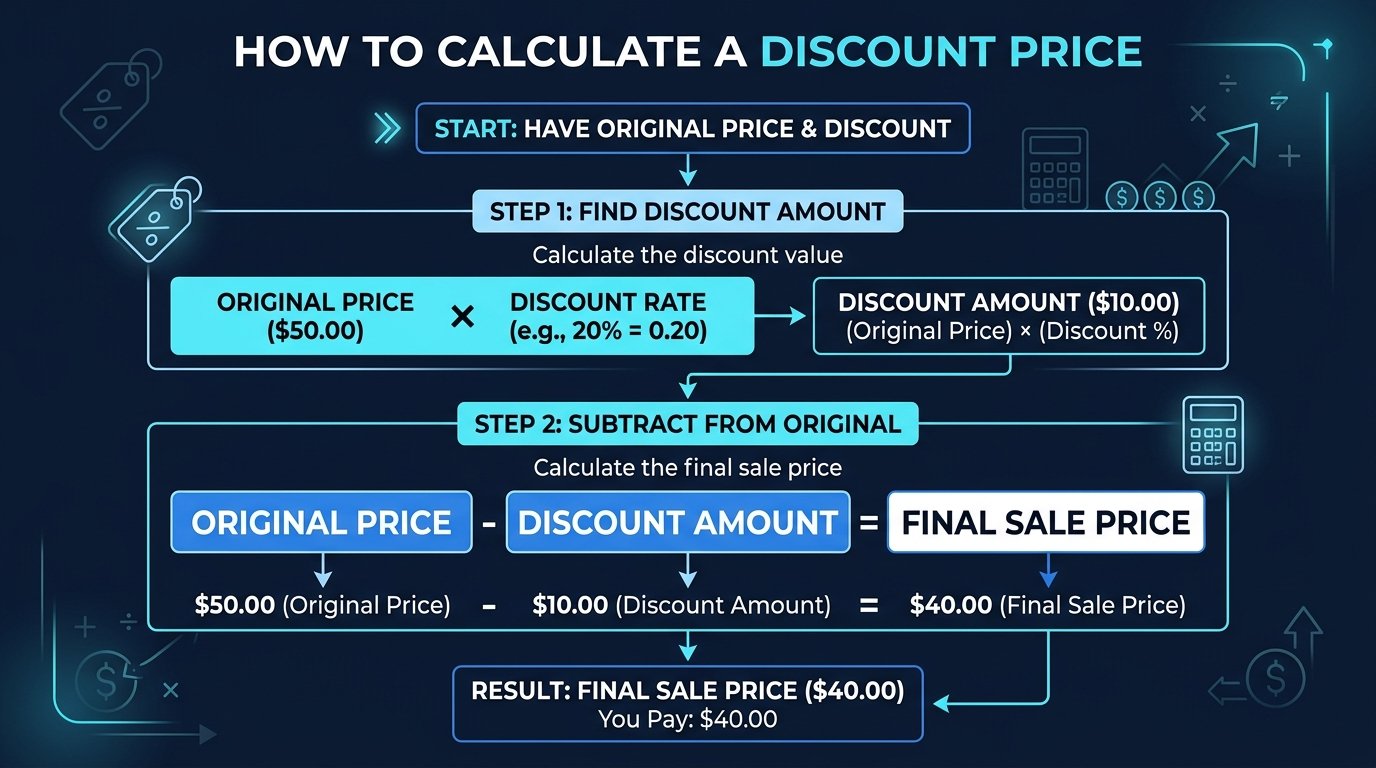
Let us examine a standard retail example. Suppose an apparel item has an original price tag of $120 and the merchant offers a 25% promotional markdown. To calculate a discount for this purchase:
For a $120 product with a 25% discount:
$120 × 0.25 = $30
The customer saves $30. In this transaction, the shopper saves exactly $30.00 from the original list price. This monetary figure represents the isolated savings amount created by the promotional markdown whenever you calculate a discount accurately.
Final Sale Price Formula and Rapid Complementary Multipliers
Once you determine the dollar amount saved, finding the final payable price requires simple subtraction:
Sale Price = Original Price − Discount Amount
Using the previous example of the $120 product with a $30 discount amount:
$120 − $30 = $90
The final price before tax is $90.
The final price before tax is $90.00. This two-step process provides full visibility into both the dollars saved and the final amount due.
Faster Sale-Price Formula: Using the Complementary Rate to Calculate a Discount
While calculating the discount amount first is helpful when you need to know isolated savings, experienced shoppers and retail cashiers often use a faster mathematical shortcut. You can calculate the amount remaining after the discount directly:
Remaining Percentage = 100% − Discount Percentage
Sale Price = Original Price × (Remaining Percentage ÷ 100)
For a 25% discount on the identical $120 item:
100% − 25% = 75%
$120 × 0.75 = $90
This single-multiplication technique allows you to compute prices instantly on handheld calculators or smartphones. For instance, when you encounter a 30% discount, simply multiply by 0.70; for 15% off, multiply by 0.85; and for 40% off, multiply by 0.60. When you need to calculate a discount across multiple store displays, this complementary multiplier method saves significant analytical time.
Stacked Discounts: Understanding Sequential Compounding Mechanics
One of the most widespread retail calculation errors occurs when shoppers encounter stacked or sequential promotional offers. Two consecutive discounts should not normally be added together as simple arithmetic sums. Retail point-of-sale software calculates consecutive discounts successively, where each subsequent markdown applies strictly to the reduced subtotal remaining after the prior discount has been deducted.
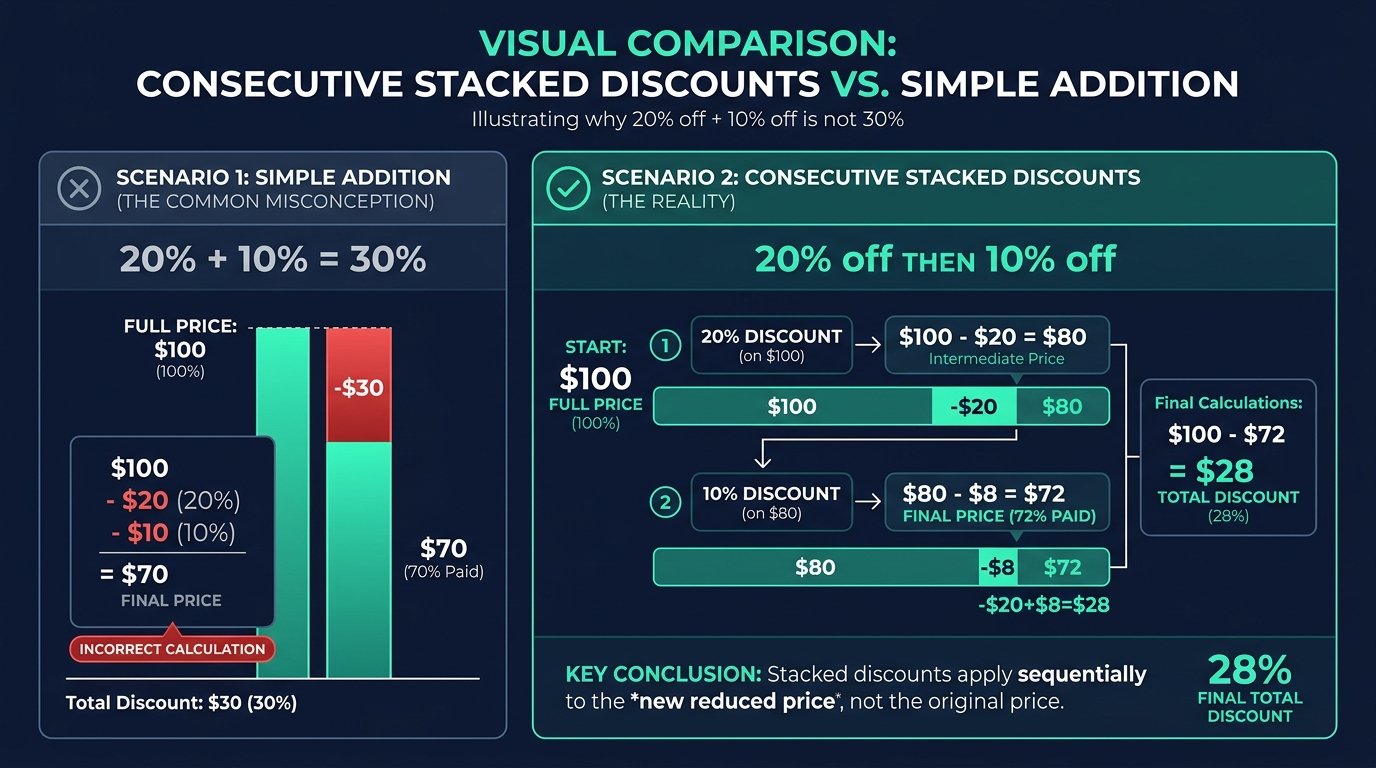
Suppose a product receives 20% off followed by another 10% off at register checkout:
- Starting price: $100
- After the first discount: $100 × 0.80 = $80
- After the second discount: $80 × 0.90 = $72
The final price is $72. The total effective discount is 28%, not 30%. Each discount applies to the price remaining after the previous discount. If the discounts were erroneously added together (20% + 10% = 30%), the expected price would be $70. The $2 discrepancy exists because the second 10% discount removed only $8 from the $80 intermediate price, rather than $10 from the original $100.
Calculating the Effective Discount Rate
For two discounts applied consecutively, you can determine the combined promotional rate using the effective multiplier formula:
Effective Remaining Rate = (1 − First Discount) × (1 − Second Discount)
Effective Discount = 1 − Effective Remaining Rate
For 20% and 10%:
0.80 × 0.90 = 0.72
Effective Discount = 1 − 0.72
Effective Discount = 28%
This mathematical law holds regardless of discount sequence. Whether the register processes 20% off first and then 10%, or 10% first and then 20%, the multiplication (0.80 × 0.90 = 0.72) produces identical payable balances. Knowing this formula ensures you always calculate a discount with complete confidence when coupons stack.
When evaluating consecutive promotional markdowns, knowing how to calculate a discount sequentially prevents costly checkout errors.
Discount and Sales Tax: Determining Final Transaction Totals
Whether tax is calculated before or after a discount depends on applicable rules and the type of promotion. In most retail transactions, store-funded price reductions reduce the gross transaction total, meaning sales tax is assessed strictly on the reduced sale price.
If tax is applied to a discounted $90 price at 8%:
Tax = $90 × 0.08
Tax = $7.20
Total = $90 + $7.20
Total = $97.20
Confirm the applicable tax treatment for the jurisdiction and transaction. In contrast to store markdowns, manufacturer coupons in certain jurisdictions are treated as third-party cash payments, requiring the consumer to pay tax on the original pre-coupon retail price. Knowing local regulations helps you calculate a discount and total register costs with total precision.
In addition, online purchases frequently incur delivery charges added after discounts. If your order total qualifies for free shipping only above a threshold like $75, the store evaluates qualification based on the post-discount subtotal. Learning how to calculate a discount together with sales tax prevents checkout surprises.
Finding the Original Price Through Reverse Discount Division
If you know the final price and discount percentage, you can reconstruct the starting list price through reverse division:
Original Price = Sale Price ÷ (1 − Discount Rate)
Suppose an item costs $75 after a 25% discount:
$75 ÷ 0.75 = $100
The original price was $100.
The original price was $100. A frequent error among shoppers is simply adding 25% of $75 ($18.75) to get $93.75, which fails because the original percentage was deducted from a larger initial base. Dividing by the complementary retention percentage (0.75) preserves mathematical accuracy whenever you need to calculate a discount in reverse.
This reverse formula is indispensable for auditing store receipts. When financial analysts calculate a discount retrospectively, dividing by the remaining decimal multiplier guarantees accurate historical accounting baselines.
Comparing Promotions: Straight Discounts vs Buy-One-Get-One Offers
Retail marketers employ diverse promotional framing mechanisms to entice shoppers. Consider two competing promotional offers on identical merchandise:
- Offer A: 30% off both items
- Offer B: Buy one, get the second item 50% off
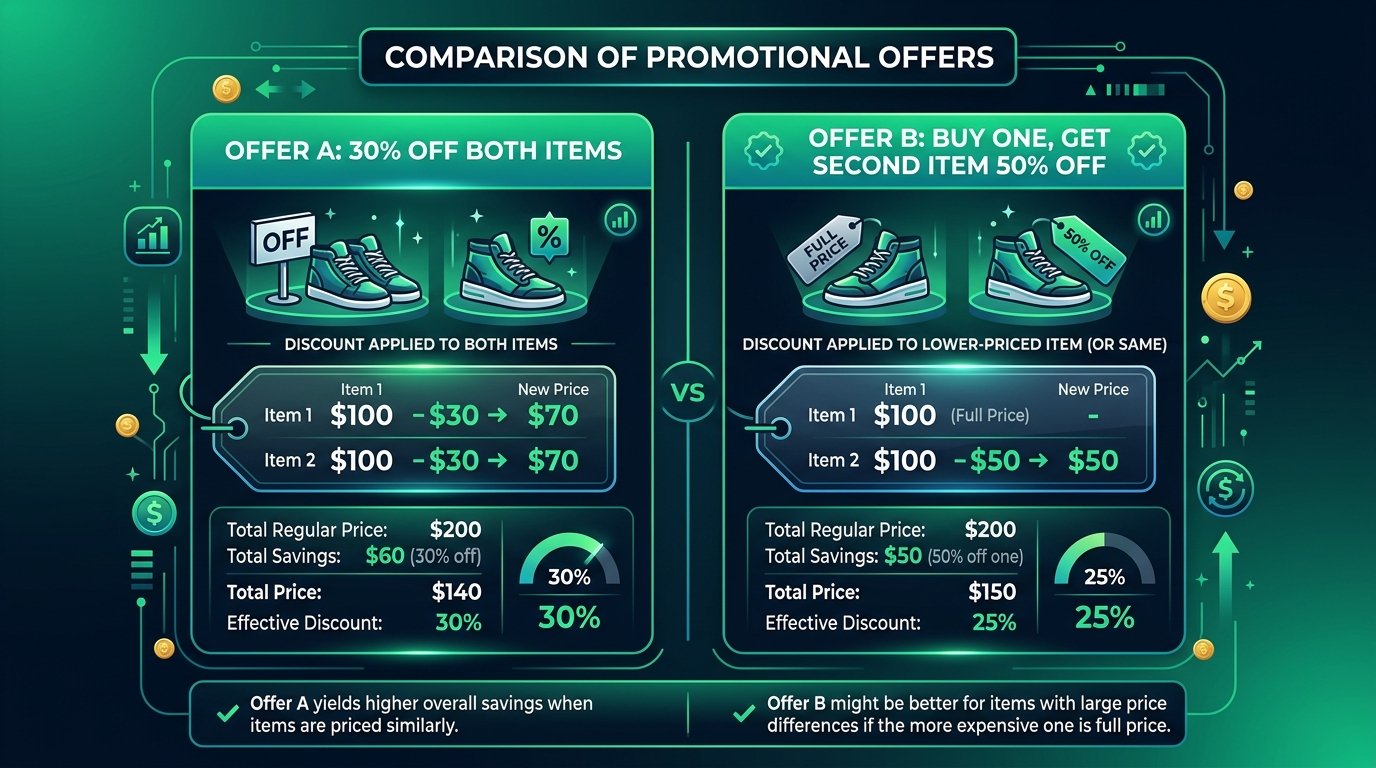
If two equal-priced items are purchased, Offer B discounts only one of them by 50%. Across both items, that is an effective 25% discount. In that case, 30% off both items provides the larger saving.
To demonstrate this mathematically, assume each product costs $100 ($200 total list value). Under Offer A, the customer receives $60 off, paying $140. Under Offer B, the first item costs $100 and the second costs $50, totaling $150. Offer A yields $10 in additional savings. Furthermore, if items differ in price, retailers discount the cheaper item. Evaluating these scenarios allows shoppers to calculate a discount objectively across competing retailers.
| Promotional Structure | Advertised Offer | Effective Basket Savings | Optimal Scenario |
|---|---|---|---|
| Flat Percentage Off | 30% off entire order | 30.0% | Single items or any basket volume |
| BOGO 50% Off | Buy 1, get 2nd 50% off | 25.0% | Pairs of equal-value items |
| BOGO Free | Buy 1, get 1 free | 50.0% | Consumables and high-demand staples |
| Order Threshold | $20 off orders over $100 | Up to 20.0% | Orders close to exact threshold limit |
Learning how to convert distinct marketing offers into normalized percentages allows consumers to objectively calculate a discount across competing retailers and select the promotion that delivers genuine financial optimization.
Commercial Margin Protection and Enterprise Discount Policies
For corporate merchants, sales executives, and e-commerce entrepreneurs, discounting represents a double-edged sword. While price cuts accelerate inventory velocity and drive customer acquisition, aggressive discounting can severely erode gross profit margins if unit economics are not modeled. Guidance published by regulatory bodies such as the Federal Trade Commission Pricing Guides mandates that baseline comparison prices must represent genuine former sales prices rather than inflated figures.
When an enterprise cuts prices by 20%, it does not simply need 20% more sales volume to break even on gross profits. If a product has a 40% initial gross margin, a 20% discount slashes the dollar gross margin in half! Consequently, the business must double its sales volume (a 100% volume increase) merely to generate the same gross profit dollars. For deeper insights into broader commercial math, explore our comprehensive suite of business utilities in the EzzDo Tools directory and our specialized Percentage Calculator.
Retailers frequently model historical elasticity before deciding to calculate a discount across clearance inventory, ensuring that promotional markdowns stimulate revenue while protecting positive operational cash flow.
Corporate financial controllers maintain strict governance frameworks to monitor and calculate a discount authorization matrix across sales teams, ensuring promotional programs preserve sustainable enterprise profitability.
7 Best Rules to Calculate a Discount and Maximize Savings
To ensure total quantitative precision whenever you navigate store sales or configure corporate billing rules, adhere to this definitive 7-step checklist to calculate a discount:
- Confirm the True Baseline Price: Verify whether promotional markdowns apply to the original MSRP sticker price or an already-discounted intermediate subtotal.
- Convert Percentages to Decimal Fractions: Always divide percentage rates by 100 before multiplying to eliminate magnitude errors in intermediate calculations.
- Apply Stacked Discounts Sequentially: Never add consecutive promotional percentages together; apply each subsequent rate strictly to the newly reduced balance.
- Utilize Complementary Multipliers for Speed: Multiply original prices directly by (1 − Discount Rate) to find final sale prices in a single efficient arithmetic step.
- Verify Local Sales Tax Regulations: Determine whether regional statutes assess sales tax on the discounted transaction price or the full pre-coupon sticker value.
- Normalize Competing Marketing Promotions: Convert complex BOGO offers and tiered threshold incentives into effective percentage savings across total units purchased.
- Maintain Full Intermediate Precision: Avoid premature decimal rounding during intermediate calculations, applying standard currency cent rounding only to final checkout totals.
Practical Implementation Workflows to Calculate a Discount in Enterprise Systems
When businesses calculate a discount across retail systems and analysts calculate a discount on invoices automated verification protects commercial accounting integrity and customer trust throughout every checkout channel.