
Text Case Styles Explained: camelCase, snake_case, Title Case and More
Compare common text capitalization styles used in writing, programming, URLs, filenames and database fields.
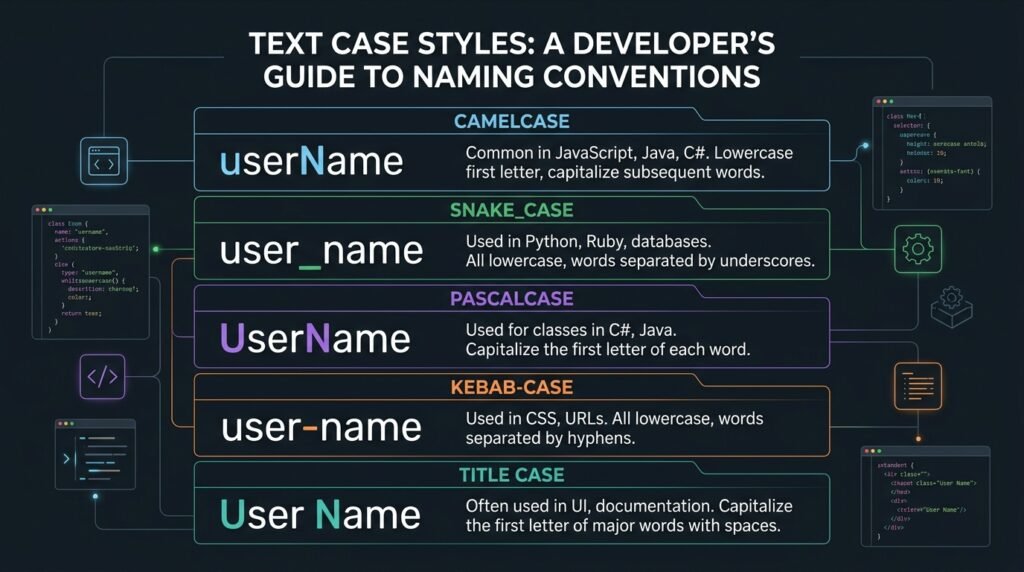
Mastering text case styles is an essential skill for software engineers, database architects, technical writers, and digital copywriters. Text case determines how letters are capitalized and how multiple words are joined or separated across digital media. Because computers process alphanumeric characters through rigid syntactic rules, choosing the right casing convention ensures code compiles cleanly, databases query efficiently, and written content remains effortless to read.
In modern software engineering and publishing, different text case styles serve dedicated technical purposes. While human readers intuitively understand spaces between words in a printed book, programming language interpreters, operating system filesystems, and web browsers often forbid whitespace or assign it reserved syntactic behavior. Consequently, standard naming conventions evolved to connect multi-word phrases into unbroken tokens.
Distinct case conventions are deployed across critical computing and editorial domains:
- Article and section headings: Structuring hierarchy across long-form technical guides.
- Programming variables and functions: Identifying memory pointers and executable methods.
- Database schemas and columns: Organizing relational tables and foreign keys.
- Web URLs and permalinks: Formatting search engine friendly route endpoints.
- Operating system filenames: Avoiding whitespace escape errors in automated bash scripts.
- Commercial product names: Establishing unique corporate trademarks and brand identities.
- Environment configuration keys: Injecting immutable credentials into application runtimes.
You can quickly transform unformatted strings between formats using EzzDo’s free Case Converter. Because our suite of EzzDo online tools operates entirely inside your local browser memory, your private code snippets, proprietary database schemas, and unpublished manuscripts remain completely confidential without transmitting data across external cloud networks.

Table of Contents
Standard Prose Formats: UPPERCASE, lowercase, and Sentence Case
Before exploring code naming conventions, examining standard prose formats illustrates how capitalization impacts human readability and optical scanning. In natural language typography, three primary text case styles govern human communication:
UPPERCASE (All Caps)
In UPPERCASE formatting, every single alphabetic letter is capitalized with no lowercase characters:
FREE ONLINE TOOLS FOR DEVELOPERS
Uppercase formatting creates high impact for system warnings, status badges, and legal disclaimers. However, reading paragraphs in all caps reduces reading speed by 20 percent. The human eye recognizes words by ascenders and descenders (such as stems in b, d, p, and q). In uppercase text, words become uniform blocks that feel like aggressive digital shouting.
lowercase (Small Letters)
In lowercase formatting, every character is transformed into small letters with zero capitalization:
free online tools for developers
While uncapitalized prose rarely appears in formal literature, lowercase represents the standard baseline for computational normalization. Software systems convert user emails, search queries, and database lookups into lowercase before performing comparisons. Because ASCII and Unicode assign different numerical byte values to uppercase and lowercase letters, normalizing text prevents authentication errors.
Sentence case
In Sentence case, only the first letter of the initial word and proper grammatical nouns are capitalized:
Free online tools for developers in California
Sentence case represents the natural cadence of written prose. Major product design systems, including Google Material Design and Apple Human Interface Guidelines, increasingly favor Sentence case for buttons, menu items, and modal dialogs. It creates a conversational, approachable interface that reduces cognitive clutter compared to rigid title casing. Comparing these fundamental text case styles illustrates why capitalization directly dictates cognitive reading effort.
Title Case Conventions: Rules, Capitalization Standards, and Nuance
Among editorial text case styles, Title Case stands out as the most complex because its rules depend entirely on editorial style manuals rather than strict mathematical algorithms. In general Title Case, major grammatical words begin with capital letters while minor function words remain lowercase:
Free Online Tools for Developers and System Architects
Publishing frameworks—such as the Chicago Manual of Style (CMOS), Associated Press (AP) Stylebook, and APA—enforce nuanced variations regarding which parts of speech warrant capitalization:
- Major Words Always Capitalized: Nouns, pronouns, verbs (including linking verbs like is and are), adjectives, and adverbs.
- Minor Words Left Lowercase: Short coordinating conjunctions (and, but, or, nor, for), articles (a, an, the), and prepositions under five letters (in, on, at, by, to, with).
- Positional Overrides: The first word and the final word of a title or subtitle are always capitalized, regardless of their part of speech.
- Hyphenated Compounds: In Chicago style, both elements of a hyphenated compound are capitalized (e.g., Client-Side Processing) unless the first element is a prefix.
Because computer parsers cannot always distinguish whether a word like in functions as a preposition or as part of a phrasal verb, automated converters provide an excellent starting point, but professional headlines should always be reviewed manually by an editor. Understanding how text case styles function in editorial titles helps writers format articles correctly across diverse publications.
camelCase vs PascalCase: Object-Oriented Code and Component Architecture
In software engineering, space characters break compiler lexical tokens. To create descriptive multi-word identifiers without spaces, developers rely on compound text case styles that use uppercase letters as visual boundaries.
camelCase (lowerCamelCase)
In camelCase, the initial word begins with a lowercase letter, and every subsequent word begins with a capital letter with no intervening whitespace:
freeOnlineToolsForDevelopers
The name stems from uppercase letters resembling the humps of a camel. In modern ecosystems, camelCase is standard for:
- JavaScript and TypeScript: Local variables, function declarations, and object properties (e.g.,
calculateTotal(),userData). - Java and Kotlin: Method names, instance variables, and parameter identifiers.
- JSON Payloads: Web API response keys communicating between browser clients and servers.
- Swift: Variable declarations and method names across iOS applications.

PascalCase (UpperCamelCase)
PascalCase follows the identical concatenation rule as camelCase, with one crucial distinction: every single word—including the initial word—begins with an uppercase letter:
FreeOnlineToolsForDevelopers
Named after the Pascal programming language, PascalCase conveys structural authority. In modern code, it is reserved for high-level constructs:
- Class Names: Object-oriented classes in Java, C++, Python, and TypeScript (e.g.,
UserManager,PaymentGateway). - React and Vue Components: Reusable user interface components (e.g.,
<UserProfile />,<NavigationBar />). - C# Methods and Properties: Microsoft .NET framework conventions mandate PascalCase for all public methods and properties.
- TypeScript Interfaces and Types: Defining data contracts (e.g.,
interface UserAccount).
Both camelCase and PascalCase represent foundational text case styles that eliminate whitespace while maintaining clear visual word boundaries across modern source code.
snake_case and CONSTANT_CASE: Python, SQL Databases, and Immutability
While capitalization transitions create word boundaries in camelCase, other text case styles employ explicit separator characters. The underscore (_) serves as the primary visual connector in data engineering and backend scripting.
snake_case
In standard snake_case, all letters are lowercase and individual words are joined by single underscores:
free_online_tools_for_developers
Readability studies show snake_case is easy to parse because underscores mimic whitespace without splitting strings. Environments standardizing snake_case include:
- Python (PEP 8): Python’s official PEP 8 Style Guide explicitly mandates snake_case for all module names, function declarations, and variable names.
- Relational SQL Databases: Database tables, column names, and index identifiers (e.g.,
user_accounts,billing_address_id). - Rust and Ruby: Method and variable definitions adhere strictly to snake_case.
- Configuration Files: YAML and JSON dictionary keys in DevOps infrastructure.
CONSTANT_CASE (SCREAMING_SNAKE_CASE)
When snake_case is converted entirely to uppercase letters, it forms CONSTANT_CASE (also colloquially known as SCREAMING_SNAKE_CASE or MACRO_CASE):
FREE_ONLINE_TOOLS_FOR_DEVELOPERS
In software engineering, CONSTANT_CASE signals to developers that a value is immutable and should never be overwritten during program execution. Common examples include:
API_BASE_URL, MAX_RETRY_COUNT, DEFAULT_TIMEOUT_MS, DATABASE_PORT
Crucially, immutability is enforced by the runtime (such as const or final)—not by naming. However, following established text case styles provides visual documentation. Both snake_case and CONSTANT_CASE are critical text case styles that keep backend code readable and expressive.
kebab-case: Web Addresses, URL Slugs, and CSS Class Formatting
Among web-focused text case styles, kebab-case is unique because it relies on the hyphen character. In kebab-case (sometimes termed dash-case, lisp-case, or spinal-case), all letters are lowercase and separated by hyphens:
free-online-tools-for-developers
The name evokes skewers piercing pieces of meat. Because the hyphen acts as a subtraction operator, kebab-case cannot be used for variables in languages like JavaScript, Python, or C#. Outside source code variables, kebab-case reigns supreme in web architecture:
- URL Slugs and Permalinks: Search engine crawlers (including Google and Bing) treat hyphens as natural word delimiters.
- CSS Classes and IDs: Standard styling frameworks follow kebab-case (e.g.,
.nav-item-active,#header-container). - HTML Custom Data Attributes: Attributes like
data-user-idand custom web components (e.g.,<app-drawer>). - CLI Flags: Command-line terminal options (e.g.,
--output-directory,--dry-run). - NPM Package Names: Node.js package registries mandate lowercase kebab-case.
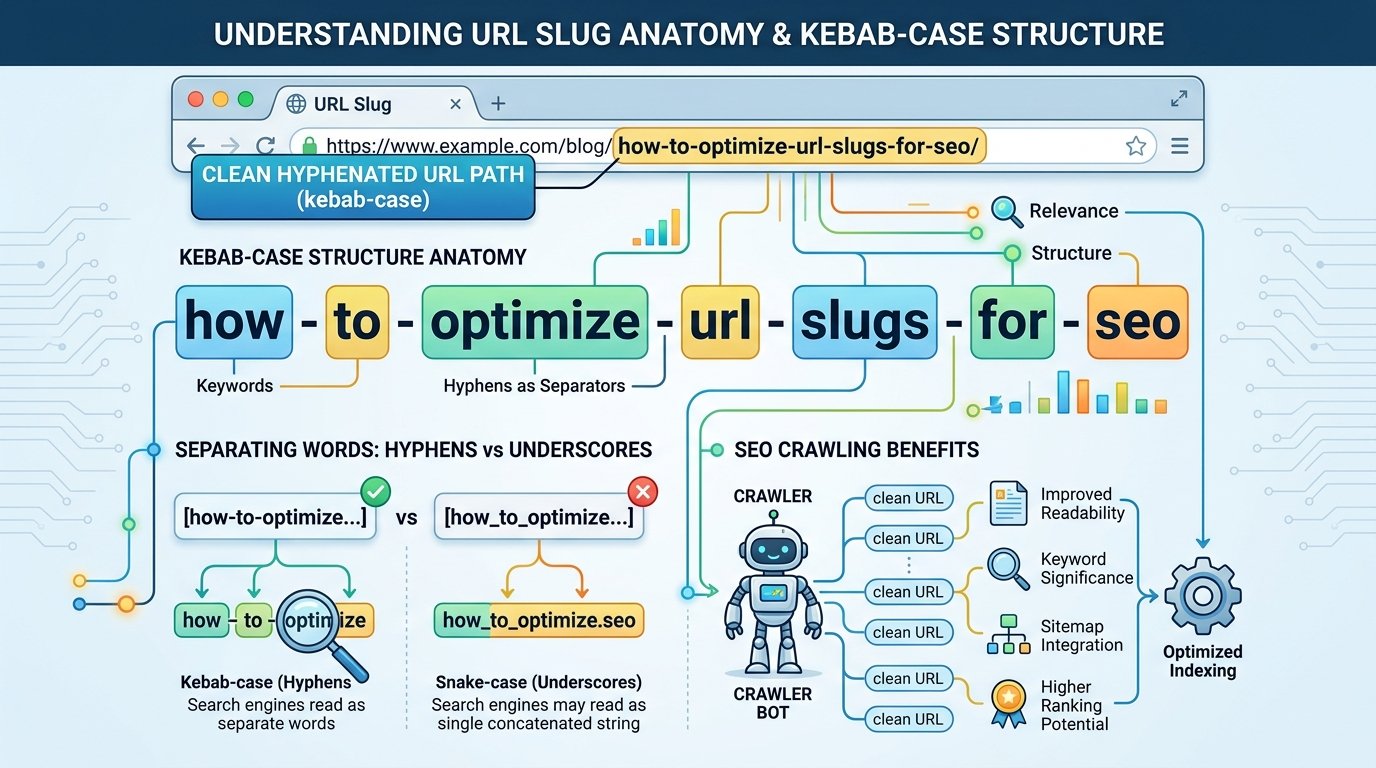
When structuring web pages, generate clean search-friendly permalinks using EzzDo’s Slug Generator. If your links contain encoded entities, verify parameters with our URL Encoder and Decoder. Adhering to clean text case styles ensures your URLs remain accessible and search-optimized.
dot.case: Configuration Keys, Package Identifiers, and Logging Namespaces
While less common in standard literature, hierarchical text case styles like dot.case serve vital configuration roles across distributed microservices. In dot.case (or period-separated case), words are lowercase and delimited by full stops:
free.online.tools.for.developers
Dot notation carries structural hierarchical meaning across software infrastructure. Rather than merely joining words, the period indicates nested sub-properties, parent-child relationships, and modular scope:
- Java and Android Package Names: Reverse domain naming (e.g.,
com.ezzdo.tools.utility). - Spring and Microservices Configuration: Property files (e.g.,
server.port,spring.datasource.url). - Logging Categories: Structured logging loggers (e.g.,
app.security.auth.token). - Internet Domain Names: Network hostnames and DNS records (e.g.,
ezzdo.site).
Because period characters carry semantic meaning, never blindly convert dots into other text case styles without understanding the downstream configuration parser.
How Text Case Styles Encounter Conversion Limitations with Acronyms and Brands
Automated software utilities provide tremendous productivity when refactoring naming conventions. However, algorithmic conversion engines face distinct linguistic limitations when transforming complex sentences. Understanding these limitations ensures your data remains error-free.
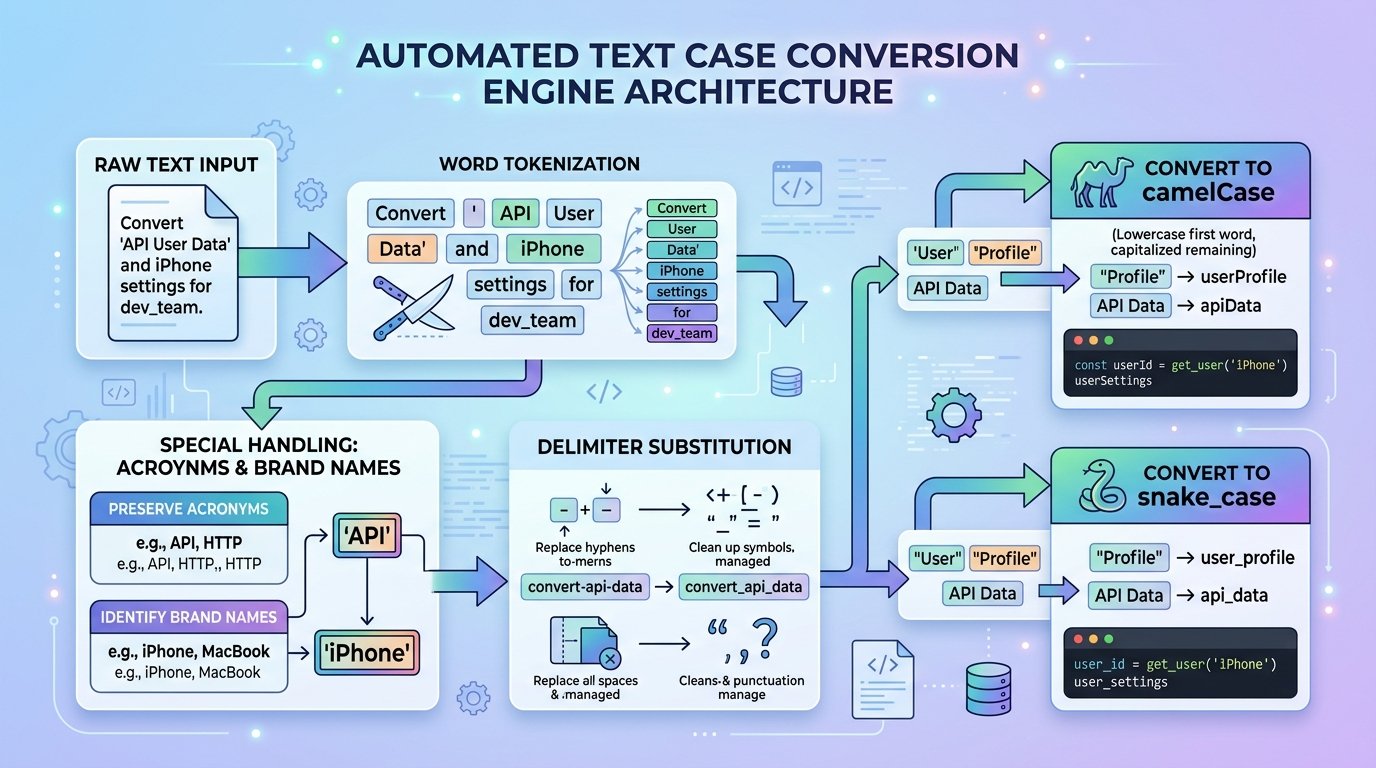
Edge Cases: How Text Case Styles Handle Acronyms and Brands
A naive conversion algorithm splits strings strictly at whitespace, hyphens, underscores, or transitions between lowercase and uppercase letters. This naive logic frequently corrupts specialized terms:
- Technical Acronyms: A phrase like parseJSONResponse contains adjacent uppercase letters (JSONR). A basic parser might split this into parse_j_s_o_n_response instead of the expected parse_json_response.
- CamelCase Brand Trademarks: Corporate brands such as iPhone, eBay, PostgreSQL, and macOS contain intentional internal capitalization that generic title casing rules flatten into Iphone or Ebay.
- Grammatical Apostrophes: Contractions like don’t or possessives like developer’s can inadvertently have their trailing letters severed or stripped during delimiter substitution.
- International Diacritics: Non-English characters (such as German umlauts ä, ö, ü or French accents é, ç) require UTF-8 aware uppercase and lowercase mappings to prevent character corruption.
When managing large lists of keywords or identifiers, clean repetitive entries first with EzzDo’s Duplicate Line Remover and analyze word length metrics using our Word Counter before running batch conversions across your codebase.
How to Convert Text Case Styles Instantly Using EzzDo’s Online Tools
Refactoring variable lists, cleaning database tables, and generating publication headlines takes seconds when using EzzDo’s dedicated utility. Transforming between diverse text case styles follows a seamless, private workflow.
Follow these straightforward steps to convert your content:
- Open the Converter: Navigate to the free EzzDo Case Converter in any web browser.
- Input Raw Text: Paste your code variables, database fields, or article headlines into the main editor canvas.
- Select Target Format: Choose your desired output style: UPPERCASE, lowercase, Title Case, Sentence case, camelCase, PascalCase, snake_case, or kebab-case.
- Inspect Result: Review the instantaneous transformation readout to verify that acronyms and numbers are positioned properly.
- Copy in One Click: Use the dedicated copy button to transfer the converted text directly to your clipboard for your IDE or document.
Because all processing executes strictly inside your browser sandbox using client-side JavaScript, sensitive proprietary code, private API tokens, and confidential corporate manuscripts never leave your machine. When you transform text case styles client-side with EzzDo, your text never leaves your device.
Frequently Asked Questions About Text Case Styles
Here are answers to the most common technical questions regarding how developers and writers implement diverse text case styles across modern software stacks.
7-Step Developer Naming Conventions Checklist
Before standardizing naming conventions across a codebase or style guide, execute this checklist to ensure that your chosen text case styles remain maintainable:
- Check Language Idioms: Follow the canonical style guides of your language (PEP 8 for Python, Effective Dart for Flutter, Google Java Style).
- Maintain Database Uniformity: Ensure all table schemas, primary keys, and foreign columns use uniform snake_case.
- Standardize URL Permalinks: Always enforce clean lowercase kebab-case for public web URLs and SEO route endpoints.
- Distinguish Classes and Instances: Enforce PascalCase for class definitions and camelCase for instantiated object variables.
- Reserve CONSTANT_CASE for True Constants: Only use uppercase letters and underscores for global values intended to remain strictly immutable.
- Preserve Brand Capitalization: Manually whitelist specialized corporate brand names (iPhone, eBay, macOS) during batch string migrations.
- Audit Case Sensitivity: Verify whether production deployment environments (such as Linux filesystems vs Windows) strictly enforce case sensitivity.
By implementing consistent conventions and understanding the architectural rationale behind different text case styles, engineering teams eliminate ambiguity, enhance code readability, and streamline collaboration across modern codebases.