
Initializing Age Calculator securely in browser…
Zero server uploads. Your data stays private on your device.
Welcome to the Age Calculator, a fast, highly accurate, and privacy-focused digital utility engineered to determine exact chronological age across multiple standard units of time. Whether preparing official legal documentation, filing civil passport applications, verifying academic enrollment eligibility, calculating insurance actuarial brackets, or simply discovering how many total days, weeks, and hours you have lived, our online age calculator delivers instantaneous calculations directly inside your web browser without transmitting sensitive personal dates across external networks.
Unlike simplistic estimation formulas that divide total days by 365 or assume every month spans exactly thirty days, this specialized age calculator executes rigorous Gregorian calendar algorithms. It dynamically evaluates variable month lengths from 28 to 31 days, accounts for quadrennial leap years, and handles century leap rules to deliver true mathematical fidelity.
For broader calendar computations, explore our companion Date Difference Calculator to measure custom working days, visit our complete EzzDo Calculators hub for financial and mathematical tools, or apply our Percentage Calculator for relative difference analysis.
Table of Contents
How to Use the Free Age Calculator
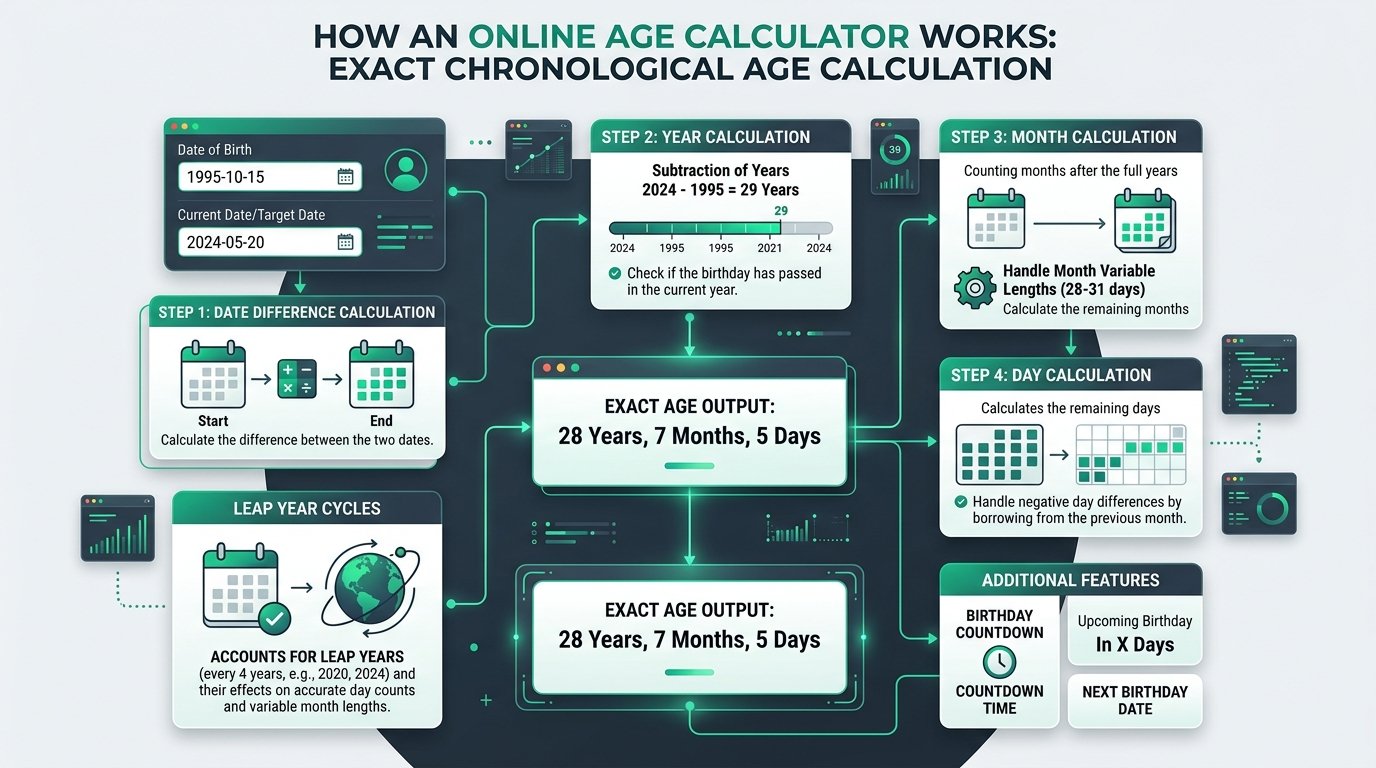
Operating our client-side age calculator is straightforward and completely friction-free. We engineered the interface to provide immediate answers without unnecessary setup steps or confusing parameters. Follow this simple 3-step workflow:
- Enter Your Date of Birth: Click the primary calendar input to select the exact day, month, and year of your birth. The interactive calendar permits rapid decade navigation, or you may type the numerical date directly using your keyboard.
- Select an Optional Target Date: By default, the age calculator evaluates your birthdate relative to today’s current date. If you need to ascertain your exact age on a historical milestone (such as military enlistment, marriage, or university graduation) or project your age on a future date (such as pension commencement or retirement), pick your designated target date in the secondary input.
- Analyze the Multi-Unit Statistics: The calculations refresh instantaneously as you make selections. Review your primary chronological breakdown (Years, Months, Days) alongside cumulative values for total elapsed months, complete calendar weeks, total days lived, and cumulative hours.
Each metric displayed by our age calculator is computed independently to ensure you possess the exact unit required for whatever form, contract, or analytical project you are completing. In addition, you can copy any individual metric with a single click to streamline administrative data entry.
Key Features of the EzzDo Age Calculator
In developing this utility, our team prioritized mathematical correctness, user privacy, and cross-device speed. The primary capabilities built into this online tool include:
- Strict Client-Side Sandboxing: Date of birth represents sensitive personal identifying information. Unlike commercial websites that upload dates to cloud analytics or advertising trackers, this age calculator executes 100% of its logic locally inside your browser memory. Your personal information never leaves your device.
- Multi-Dimensional Metric Output: Instantly view life duration expressed in primary calendar components (Years, Months, Days) as well as total aggregate weeks, cumulative days, hours, and minutes.
- Integrated Birthday Countdown: The tool automatically calculates the precise number of months and days remaining until your next birthday anniversary and highlights the specific day of the week on which your celebration will occur.
- Astronomical Leap Year Calibration: Built-in calendar logic conforms with official NIST timekeeping and leap year guidelines, correctly incorporating February 29 quadrennial leap days.
- Fluid Keyboard Accessibility & Screen Reader Semantics: Designed for total accessibility compliance, featuring high-contrast ARIA tags, structured tab navigation, and clear screen-reader announcements when date calculations complete.
- Zero-Latency Microsecond Processing: Built with lean, optimized JavaScript that performs calendar computations in less than five milliseconds, ensuring smooth, lag-free responsiveness across budget mobile devices and desktop computers.
- Zero Installation or Registration: Free forever, functioning instantly on mobile phones, tablets, laptops, and desktop computers without logins, captchas, or subscriptions.
Mathematical Mechanics of Chronological Age Calculation
Chronological date arithmetic is deceptively intricate because human calendar units lack fixed mathematical durations. A standard day consistently comprises 24 hours (86,400 seconds), but months fluctuate between 28, 29, 30, and 31 days. Furthermore, common calendar years contain 365 days whereas leap years contain 366 days. To solve these calendar variations without introducing off-by-one errors, our chronological calculator implements a 5-stage algorithm:
1. Preliminary Annual Subtraction
The calculation starts by subtracting the birth year from the target year: Years = Target Year - Birth Year. If the target date’s month and day precede the birth anniversary in the current calendar year, the preliminary year count is decremented by one because the full annual cycle has not yet concluded.
2. Calendar Month Evaluation and Day Borrowing
Next, the day component is calculated. When the target day is smaller than the birth day (such as calculating from May 25 to June 10), the computation borrows the exact number of days from the preceding month. For example, borrowing from May adds 31 days, borrowing from April adds 30 days, and borrowing from February adds 28 or 29 days depending on whether the target period spans a leap year.
3. Leap Year Cycle Reconciliation
Leap years exist to reconcile the standard 365-day Gregorian calendar with Earth’s astronomical solar orbit, which takes approximately 365.2422 solar days. Under the Gregorian leap year standard, a year is a leap year if divisible by 4, except for end-of-century years which must also be divisible by 400. Thus, years 1996, 2000, 2004, 2020, and 2024 are leap years, whereas 1900 and 2100 are common years. The age calculator accounts for every leap day spanned.
4. High-Precision Epoch Timestamp Conversion
To compute cumulative metrics (total days, total weeks, and total hours lived), the tool translates both dates into coordinated universal time (UTC) millisecond timestamps. Subtracting start milliseconds from end milliseconds and dividing by 86,400,000 yields exact total days lived, free from local daylight saving shifts.
5. ISO 8601 Calendar Interoperability
To prevent regional date ambiguity (such as confusing March 4 with April 3 in MM/DD/YYYY vs DD/MM/YYYY notations), our age calculator internally adheres to the ISO 8601 extended calendar format (YYYY-MM-DD). This ensures standard global interoperability across databases, APIs, and legal administrative registries.
Step-by-Step Manual Math: Calculating Age by Hand
Understanding the manual arithmetic allows engineers, students, and legal professionals to independently verify results without relying entirely on automated scripts. Consider a practical demonstration: calculating exact chronological age for someone born on March 24, 1998 evaluated on October 15, 2026:
- Align Dates in Columnar Format: Write Target Date (2026-10-15) above Birth Date (1998-03-24).
- Subtract Days (15 minus 24): Since 15 is smaller than 24, borrow 1 month from the target month column (October becomes 9 months). The preceding month to October is September, which has 30 days. Add 30 days to 15:
15 + 30 = 45 days. Now subtract:45 - 24 = 21 days. - Subtract Months (9 minus 3): We now evaluate the remaining months:
9 - 3 = 6 months. - Subtract Years (2026 minus 1998): Finally, subtract the calendar years:
2026 - 1998 = 28 years. - Final Assembly: The exact calculated age is 28 Years, 6 Months, and 21 Days.
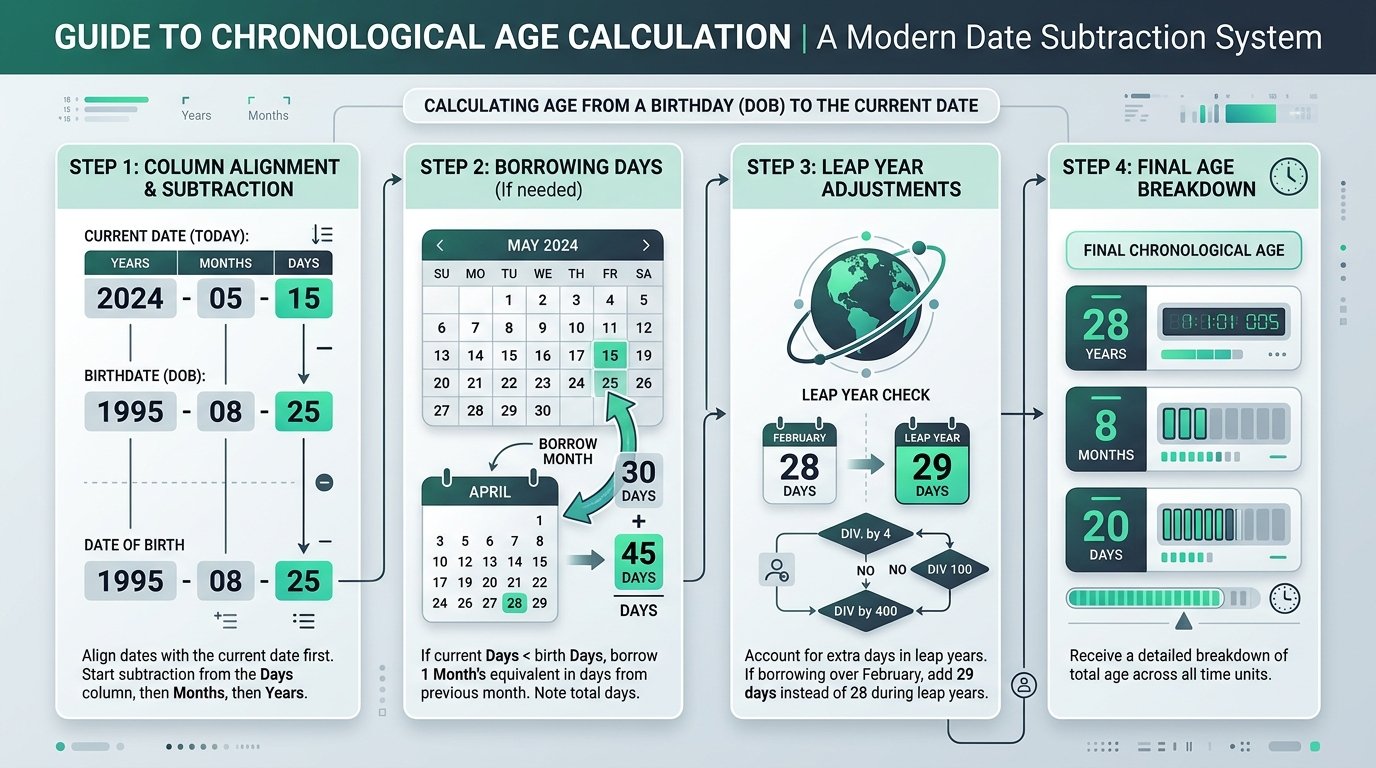
Notice how critical step 2 is: borrowing days requires referencing the exact calendar month immediately preceding the target month, rather than a generic average of 30 days. This precision is precisely what our online age calculator automates in milliseconds.
Consider a second challenging scenario: evaluating an individual born on a leap day (February 29, 2000) evaluated on March 1, 2026. Because year 2026 is a standard common calendar year, February contains exactly 28 days. Subtracting the dates yields 26 completed years, zero completed months, and exactly 1 day. Performing these multi-variable calculations by hand requires extreme diligence, making client-side automation an invaluable convenience for everyday verifications.
Similarly, when computing dates across year boundaries (such as December 31 to January 1), borrowing must properly transition back to December of the previous year with 31 days. Practicing these manual calculations highlights the necessity of robust edge-case validation.
Reference Scenarios and Output Comparison Table
To illustrate how the age calculator resolves complex date boundaries and month borrowing, review the worked scenarios detailed in the table below:
| Birth Date | Reference Date | Chronological Age Output | Total Days Lived | Calendar Consideration |
|---|---|---|---|---|
| 1995-10-15 | 2026-10-24 | 31 Years, 0 Months, 9 Days | 11,332 Days | Spans 8 leap years (1996, 2000, 2004, 2008, 2012, 2016, 2020, 2024) |
| 2000-02-29 | 2026-03-01 | 26 Years, 0 Months, 1 Day | 9,497 Days | Leap day birthday evaluated in common calendar year |
| 1980-06-01 | 2026-10-24 | 46 Years, 4 Months, 23 Days | 16,946 Days | Includes 556 completed months with variable days |
| 2010-12-31 | 2026-01-01 | 15 Years, 0 Months, 1 Day | 5,480 Days | Cross-year boundary transition calculation |
| 2005-08-15 | 2026-08-15 | 21 Years, 0 Months, 0 Days | 7,670 Days | Exact milestone birthday with zero remaining days |
As demonstrated in the comparison table, individuals born in different months with identical total completed years can experience different total day totals due to the placement of 31-day months. This illustrates why an exact online age calculator is essential for legal and technical calculations.
Chronological Age vs Cultural Age Reckoning Systems
While our age calculator implements the international standard chronological framework, different civilizations and global traditions have historically calculated human age using distinct methodologies:
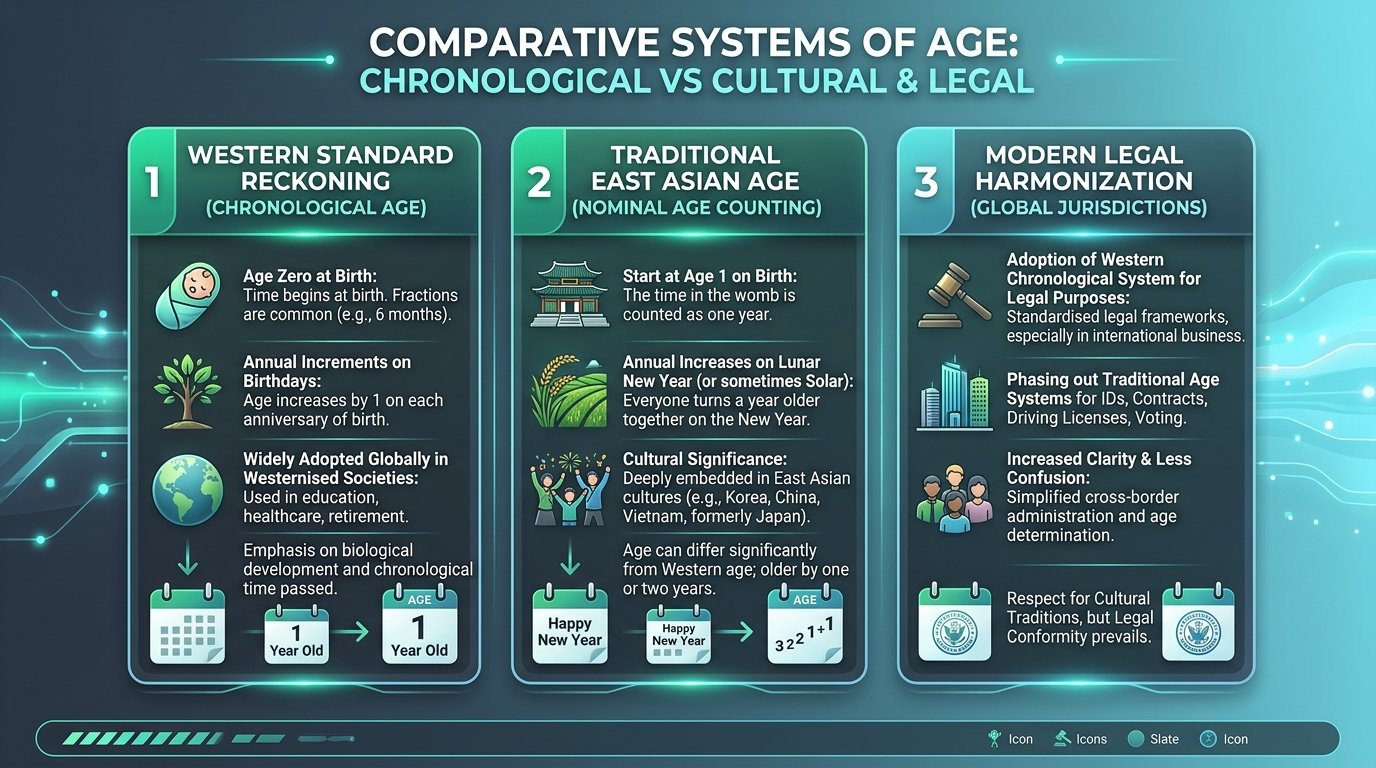
- International Chronological Age (Western Standard): A newborn starts at age zero on the day of birth. The individual reaches age 1 precisely one year later on their first birthday anniversary. This standard governs global civil law, international air travel, medical prescriptions, and employment standards.
- Traditional East Asian Age Reckoning: Historically utilized across China, Japan, Korea, and Vietnam, a child was considered one year old on the day of birth. Additionally, everyone’s age advanced simultaneously by one year on New Year’s Day, regardless of their individual date of birth. Consequently, a baby born in late December would turn two years old just days later at the new year.
- Modern Legal Harmonization: To eliminate confusion in international trade and civil administration, virtually all governments have standardized on the international system. In June 2023, South Korea officially abolished the traditional nominal age system for administrative, civil, and judicial affairs, bringing official state records into alignment with international age calculator methods.
Historical Evolution of Calendar Systems and Age Tracking
Humanity’s ability to measure personal age with day-level precision is a relatively modern scientific luxury. For millennia, agricultural societies tracked life stages by seasonal cycles, lunar phases, or monarchical reigns rather than exact solar birthdates.
The introduction of the Julian calendar by Julius Caesar in 45 BCE represented a monumental advance, instituting a 365-day year with a leap day every four years. However, because a solar year is roughly 365.2422 days rather than 365.25 days, the Julian calendar gained approximately 3 days every 400 years. By 1582, calendar dates had drifted ten full days out of synchronization with the spring equinox.
Pope Gregory XIII resolved this drift by establishing the Gregorian calendar, eliminating ten days in October 1582 and refining leap year rules so that century years not divisible by 400 do not add a leap day. Today, our digital age calculator incorporates this Gregorian timeline to guarantee seamless chronological consistency across four centuries of historical records.
Modern time standards maintain synchronization via coordinated universal time (UTC) atomic clocks managed by the International Bureau of Weights and Measures. When converting personal milestones across multiple decades, digital date arithmetic tools eliminate historical discrepancies and leap second drifts to maintain absolute precision.
Legal Milestones and Statutory Age Verification
Determining precise chronological age is a foundational requirement across numerous legal, educational, and statutory contexts. Important verification milestones where an accurate age calculator is commonly deployed include:
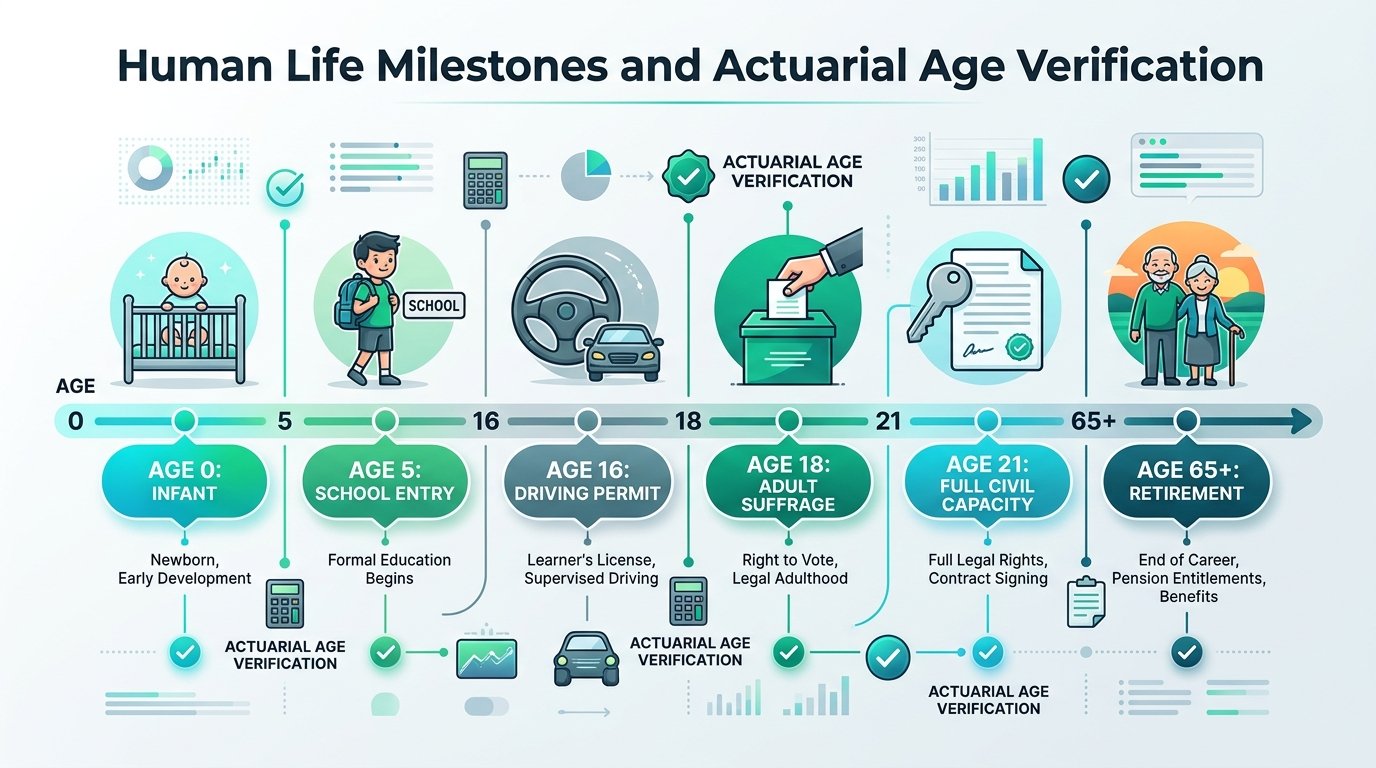
- Academic and Kindergarten Enrollment: School districts mandate rigid date cutoffs (such as requiring a child to have attained 5 years of age on or before September 1) to establish classroom eligibility.
- Driver Permits and Licensing: Transportation authorities require applicants to achieve exact statutory ages (such as 16 years for provisional driving and 18 for commercial endorsements) on the date of examination.
- Electoral Enfranchisement: Democratic jurisdictions establish constitutional requirements stipulating that voters must celebrate their 18th birthday on or before election day to cast a ballot.
- Commercial Aviation and Maritime Certifications: International commercial airline pilots are subject to mandatory retirement ages (regulated at age 65 by ICAO standards), requiring precise chronological age audits to maintain operational certification.
- Commercial and Contractual Capacity: Valid execution of commercial real estate contracts, corporate credit applications, and binding financial agreements mandates verification of majority age.
Actuarial Age Calculations and Insurance Standards
Beyond simple civil birthdays, financial and insurance sectors employ specialized age conventions to calculate mortality tables, annuity payouts, and underwriting risks:
- Age Last Birthday (ALB): The standard convention utilized in civil law and consumer applications where an individual remains a specific age until their next official birthday anniversary.
- Age Nearest Birthday (ANB): Frequently utilized in life insurance underwriting. Under ANB rules, once an individual passes the exact midpoint of their annual birthday cycle (six months past their last birthday), their insurance age advances to the upcoming milestone. For example, a person aged 34 years and 7 months is classified as age 35 for life insurance premium calculations.
- Social Security Full Retirement Age (FRA): Modern social security legislation specifies full retirement eligibility in precise increments of years and months (such as 66 years and 8 months or 67 years), directly determining monthly retirement payout percentages. Our age calculator allows users to verify their exact standing against these federal brackets.
- Actuarial Present Value and Mortality Tables: Life insurers project cohort survival probabilities based on exact attained age, determining cash surrender values and policy reserves with rigorous mathematical accuracy.
Common Age Calculation Pitfalls and How to Avoid Them
Manual age estimation frequently results in significant errors. When calculating age by hand or utilizing flawed formulas, watch out for these prevalent pitfalls:
- The Fixed 30-Day Month Fallacy: Dividing days by 30 produces inaccurate month counts because seven months have 31 days and February has 28 or 29. True chronological age requires step-by-step calendar month counting.
- The 365.25 Day Averaging Error: Dividing total days by 365.25 can cause milestone birthdays to register one day early or late due to fractional rounding.
- Timezone and International Dateline Shifting: Storing birthdates as UTC timestamps without timezone awareness can shift your recorded birth date by an entire calendar day. Our age calculator evaluates dates in your local device timezone to prevent date shifts.
- Daylight Saving Time (DST) Transitions: When clocks advance in spring or fall back in autumn, naive 24-hour timestamp division can skew calculated durations by an hour. EzzDo normalizes all timestamps to standard midnight boundaries, completely eliminating daylight saving time clock drift.
- Inclusive versus Exclusive Date Counting: In legal contexts, knowing whether the start date and end date are both counted (inclusive) or whether only elapsed 24-hour periods are counted (exclusive) is critical for statutory compliance.
Frequently Asked Questions
How does the age calculator handle leap years?
The age calculator evaluates every year traversed between your date of birth and reference date. It properly identifies February 29 leap days and credits them to your total elapsed days and weeks, ensuring mathematical precision.
What happens if I was born on February 29?
If you were born on a leap day, the age calculator calculates your exact completed years and days. In common years without a February 29, civil jurisdictions legally recognize your anniversary on March 1, which the tool handles transparently.
Can I calculate what age I will be on a future date?
Yes. Enter your birthdate and select any future reference date in the secondary picker. The age calculator immediately projects your exact chronological age, total days lived, and countdown for that future day.
Is my date of birth recorded on any server?
No. EzzDo operates on a strict zero-server-upload architecture. All date parsing and calculations execute entirely in your local web browser memory. No personal data, birth dates, or IP logs are ever stored.
How are total hours lived calculated?
The tool measures the exact elapsed 24-hour days between midnight of your birth date and midnight of your reference date, multiplying the total days by 24 hours. Local timezone boundaries are respected to maintain mathematical fidelity.
Can this online age calculator be used for official school and passport applications?
Yes. The chronological year, month, and day breakdown produced by the age calculator adheres to standard international civil registration conventions used by passport agencies and educational institutions worldwide.
How do insurance companies calculate Age Nearest Birthday vs Age Last Birthday?
Under Age Last Birthday (ALB), your age equals completed years since birth. Under Age Nearest Birthday (ANB), if you are six months or more past your last birthday, underwriters round your age up to your next milestone birthday for actuarial tables.
Explore Companion Calculators and Utilities
Once you have calculated your chronological age, explore our complete collection of privacy-centric online tools designed for instant browser execution:
Date Difference
Calculate exact days, weeks, months, and business days between any two calendar dates.
Percentage Calculator
Compute percentage increases, decreases, discounts, and proportional difference formulas.
ROI Calculator
Measure return on investment, net profits, and annualized commercial growth rates.
Break-Even Calculator
Determine unit break-even thresholds and profit margins for strategic business planning.
BMI Calculator
Calculate Body Mass Index and healthy weight classifications across metric and imperial units.
Loan & EMI Calculator
Estimate monthly EMI payments, amortization schedules, and cumulative financing interest.