
Generate Unique IDs for Applications and APIs
Explore common identifier formats, understand when to use UUIDs, and learn how to reduce the risk of duplicate IDs in software projects.
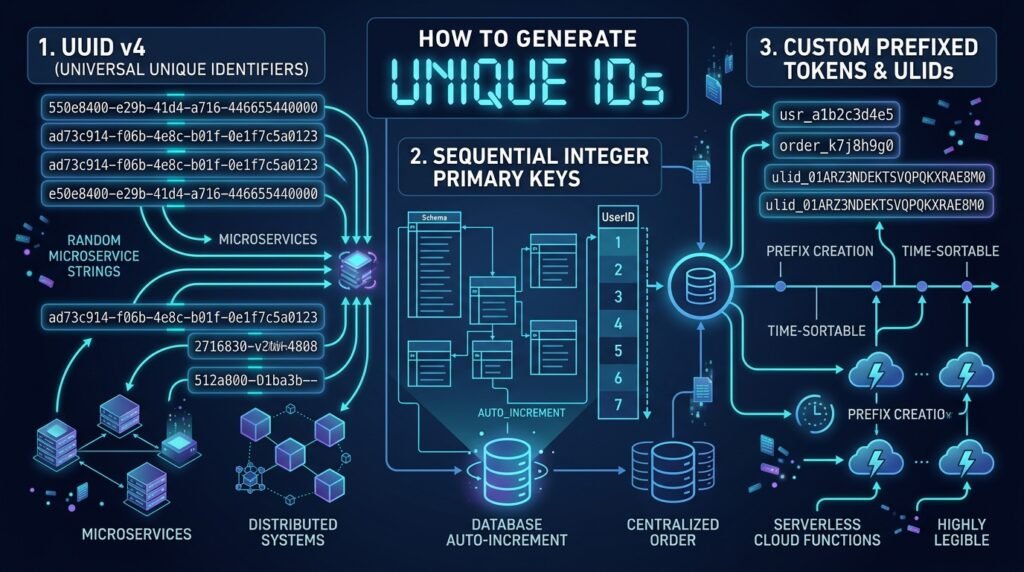
Learning how to generate unique IDs for applications, web APIs, and distributed database architectures is one of the most fundamental design decisions software architects and backend engineers face. Modern software ecosystems manage millions of distinct entities—including registered user accounts, transaction ledgers, digital orders, microservice events, and media assets. Without robust, collision-resistant identification strategies, relational databases suffer data corruption, distributed nodes overwrite state, and public API interfaces become vulnerable to resource enumeration attacks.
For instance, an enterprise e-commerce platform may process thousands of concurrent orders containing products with nearly identical descriptions. Relying on mutable business attributes like product titles or customer email addresses to index records introduces catastrophic failure points. Instead, engineering teams generate unique IDs to establish immutable, tamper-proof keys that uniquely identify resources across the entire application lifecycle. Whether selecting sequential integers, Universally Unique Identifiers (UUIDs), or custom prefixed tokens, your choice profoundly influences storage efficiency, query speed, and system security.
You can use EzzDo’s free UUID/GUID Generator to generate compliant RFC 4122 and RFC 9562 identifiers instantly within your browser with zero network latency. If your systems handle structured payloads and web protocols, review our practical guide on how to format and validate JSON, or explore our tutorial on URL encoding and decoding explained for web APIs.

Selecting an identifier format requires balancing competing engineering priorities: storage overhead, write throughput, index fragmentation, security opacity, and distributed coordination. In this technical guide, we analyze the core mathematical mechanics of uniqueness, evaluate sequential vs. random vs. time-ordered identifiers, explore cryptographic implementations in JavaScript and Python, and provide a 5-step framework to help you generate unique IDs with absolute reliability.
Table of Contents
What Is a Unique Identifier? Scopes, Cardinality, and Collision Physics
At its theoretical core, a unique identifier is an immutable token assigned to an entity to distinguish it from all other entities within a clearly defined namespace or domain. Formally defined under international standards such as IETF RFC 9562 (which obsoletes RFC 4122), unique identifiers establish unambiguous identity without relying on external context.
Uniqueness is never absolute in a vacuum; it is strictly bounded by scope. Consider the three universal scopes used when software systems generate unique IDs:
- Table Scope (Local Uniqueness): An identifier is unique only within a single relational database table. For example, primary key
101exists in theuserstable, while primary key101also exists in theproductstable. The table name provides the disambiguating namespace. - System Scope (Application Uniqueness): An identifier is guaranteed to be unique across all tables and services within a single enterprise organization. A transaction ID like
tx_88a91cmaps to exactly one financial ledger event across the entire company. - Global Scope (Universal Uniqueness): An identifier is guaranteed to be unique across all machines, organizations, and networks worldwide without requiring central authority coordination. This is the explicit design goal when developers generate unique IDs using UUID v4 or UUID v7 standards.
The mathematical guarantee of uniqueness relies on entropy cardinality. When an identifier format provides 122 bits of cryptographic randomness, the total number of distinct states is 2122 (approximately 5.3 × 1036). To contextualize this scale: if a distributed cluster were to generate 1 billion random identifiers every second for 100 consecutive years, the probability of a single duplicate key collision would remain below one in a billion. Understanding entropy allows engineers to generate unique IDs with complete mathematical confidence.
3 Core Identifier Strategies: Sequential Numbers, UUIDs, and Custom Tokens
Modern software engineering leverages three distinct paradigms when applications generate unique IDs. Each strategy introduces deliberate trade-offs across storage density, readability, and coordination requirements:

1. Sequential Auto-Incrementing IDs
Sequential identifiers operate via an incrementing integer counter managed directly by a centralized database engine (e.g., MySQL AUTO_INCREMENT or PostgreSQL BIGSERIAL):
1001, 1002, 1003, 1004, 1005Advantages: Extremely compact (4 bytes for standard INT, 8 bytes for BIGINT), human-readable, and perfectly ordered. Because numbers increment monotonically, database B-Tree indexes append new rows to the rightmost leaf page with zero page splits and optimal cache locality.
Limitations: Requires a single centralized database coordinator to allocate numbers, creating a severe bottleneck for multi-region microservices. Furthermore, sequential IDs are predictable, exposing commercial metrics (order volume) to competitors.
2. Universally Unique Identifiers (UUIDs)
UUIDs are standardized 128-bit numbers formatted as 32 hexadecimal digits displayed in five hyphen-separated blocks (8-4-4-4-12):
550e8400-e29b-41d4-a716-446655440000
f47ac10b-58cc-4372-a567-0e02b2c3d479
Advantages: Can be generated completely independently across millions of edge devices, client browsers, and microservices without network round-trips. When systems generate unique IDs with UUIDs, cross-cluster database collisions are practically non-existent.
Limitations: Consumes 16 bytes in native binary storage or 36 bytes as a string. Random distribution (UUID v4) causes severe B-Tree page fragmentation in large tables, increasing disk I/O.
3. Custom Prefixed Identifiers (Stripe-Style Tokens & TypeIDs)
Popularized by modern API pioneers like Stripe and GitHub, custom prefixed identifiers append a human-readable entity type to a high-entropy random string:
usr_9j2K1lM0p9Q
inv_2026_x78ab12
ord_1a8f9c32d4e
Advantages: Highly legible for developers inspecting API payloads and customer support logs. The prefix immediately communicates the entity type, preventing engineers from passing an order ID where a customer ID was expected.
Limitations: Requires custom generation and validation logic inside application code. Unless paired with a structured binary schema, custom strings can degrade database indexing performance compared to native integer types.
UUID vs. Sequential ID: Architectural Comparison and Trade-Off Matrix
Choosing whether to generate unique IDs using auto-incrementing integers or 128-bit UUIDs represents a fundamental architectural decision. The following detailed matrix compares both strategies across operational dimensions:
| Architectural Criteria | Sequential Auto-Increment ID | UUID v4 (Random) | UUID v7 (Time-Ordered) |
|---|---|---|---|
| Storage Size (Binary) | 4 or 8 Bytes (BIGINT) | 16 Bytes | 16 Bytes |
| Storage Size (String) | ~4–10 Characters | 36 Characters (with hyphens) | 36 Characters (with hyphens) |
| Decentralized Generation | Impossible (Single DB Counter) | Native (Zero Coordination) | Native (Zero Coordination) |
| B-Tree Index Fragmentation | Zero (Monotonic Appends) | Severe (Random Insertion Splits) | Minimal (Chronologically Sorted) |
| Security / Enumeration Defense | Extremely Vulnerable (Predictable) | Impenetrable (Opaque Entropy) | Impenetrable (Opaque Entropy) |
| Human Readability | High (Short Numbers) | Low (Dense Hexadecimal) | Low (Dense Hexadecimal) |
| Multi-Region Database Replication | Complex (Requires Offset Steps) | Seamless (No Collisions) | Seamless (No Collisions) |
As the comparison table illustrates, no single identifier strategy is universally optimal across all tiers of an enterprise stack. Many modern microservice architectures utilize a hybrid model: using compact sequential integers for internal database table joins while choosing to generate unique IDs via UUIDs for public API parameters and customer-facing URLs.
How Decentralized UUIDs Power Distributed Microservices and Offline Apps
To appreciate why modern cloud architectures rely on UUIDs, consider what happens when disconnected clients create records independently. In an auto-increment architecture, assigning primary keys requires synchronous communication with a centralized database leader:
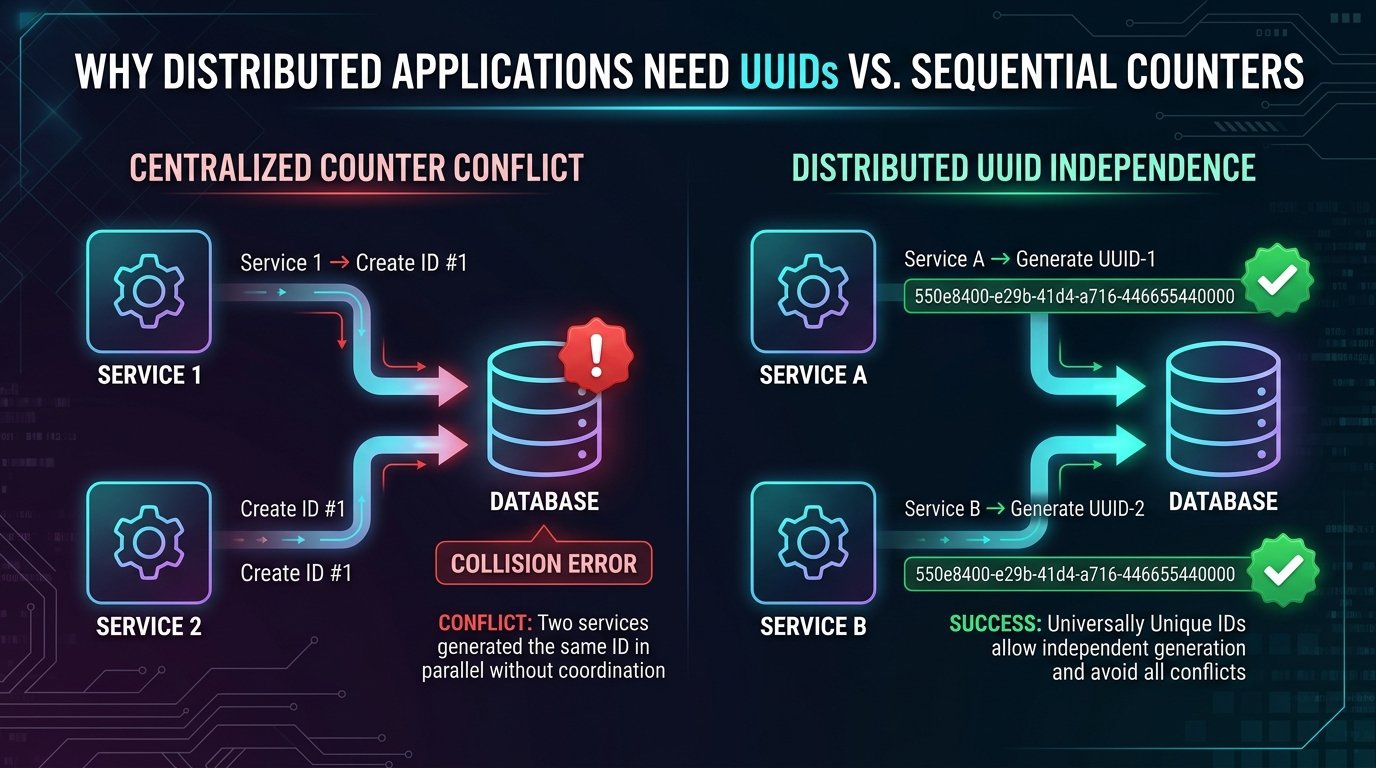
Imagine two mobile devices operating in airplane mode while inspecting field equipment. If both devices rely on local sequential counters starting at 1, both devices will inevitably assign ID = 1 to their first local inspection report. When the mobile devices reconnect to the central cloud database, an irreconcilable primary key collision occurs, requiring complex record re-mapping that breaks foreign key dependencies.
When engineering teams generate unique IDs using decentralized UUID algorithms, the mobile clients generate globally unique 128-bit identifiers locally. Upon re-establishing network connectivity, records merge into PostgreSQL or MongoDB clusters cleanly with zero primary key collisions. This decentralized autonomy is essential for:
- Offline-First Mobile Applications: Creating local draft orders, cached notes, and synchronized files without blocking user workflows.
- Event-Driven Kafka Pipelines: Assigning unique event trace IDs at edge ingress gateways before messages hit backend streaming brokers.
- Multi-Region Active-Active Databases: Eliminating master-master auto-increment allocation locks across global cloud datacenters.
By removing central coordinator dependencies, decentralized identifiers unlock horizontal scalability across modern cloud architectures.
The Evolution of UUIDs: RFC 4122, UUID v4, and RFC 9562 Time-Ordered UUID v7
The IETF published RFC 9562 in 2024 to modernize identifier specifications and resolve the database performance drawbacks of legacy UUID versions. Understanding the differences between UUID versions helps software architects choose the right algorithm when they generate unique IDs:
- UUID v1 (Timestamp + MAC Address): Uses a 60-bit Gregorian timestamp combined with the machine’s hardware MAC address. While sequential, it leaks hardware network addresses and timestamp creation metadata, posing serious privacy and security risks.
- UUID v4 (Random Entropy): Uses 122 bits of cryptographically secure random bits, setting 4 bits for version (0100) and 2 bits for variant (10). It provides total privacy and zero leaks, but its purely random nature creates severe index fragmentation in high-throughput databases.
- UUID v7 (Time-Ordered Monotonic): The modern standard defined in RFC 9562. UUID v7 embeds a 48-bit millisecond Unix epoch timestamp in the most significant bits, followed by 74 bits of cryptographic entropy. This enables identifiers to sort naturally in chronological order while maintaining global uniqueness.
UUID v7 solves the classic dilemma: it delivers the decentralized autonomy of UUID v4 alongside the optimal B-Tree clustering performance of sequential auto-increment keys. Forward-thinking engineering organizations are rapidly adopting UUID v7 as their standard strategy to generate unique IDs for high-scale databases.
How to Generate Unique IDs in JavaScript and Python with Zero Collisions
When developing production services, engineers must avoid naive random number implementations (such as Math.random()) which lack cryptographic entropy and suffer high collision risks. Below are robust, production-ready code examples in JavaScript and Python.
1. Native JavaScript (Browser & Node.js 16+)
Modern ECMAScript platforms provide high-performance cryptographic UUID generation natively via the Web Cryptography API under the MDN crypto.randomUUID() specification:
// Generate a standard RFC 4122 UUID v4
const uniqueId = crypto.randomUUID();
console.log("Generated UUID v4:", uniqueId);
// Output: "36b8f84d-df4e-4d49-b662-bcde71a8764f"

// Generate a Stripe-style custom prefixed identifier
function generatePrefixedId(prefix) {
  const rawId = crypto.randomUUID().replace(/-/g, "");
  return `${prefix}_${rawId.slice(0, 16)}`;
}

const orderId = generatePrefixedId("ord");
console.log("Order Token:", orderId);
// Output: "ord_36b8f84ddf4e4d49"
2. Python Native UUID Module
Python provides the built-in uuid module in its standard library to generate unique IDs using cryptographically secure operating system entropy:
import uuid

# Generate a cryptographically secure UUID v4
session_id = uuid.uuid4()
print(f"UUID v4 String: {session_id}")
# Output: "c9a646d3-9c61-4cd9-bc15-4dda270d6d11"

# Access raw 16-byte binary representation for database efficiency
raw_bytes = session_id.bytes
print(f"Binary length: {len(raw_bytes)} bytes")
# Output: 16 bytes
Both native APIs leverage operating system entropy pools (such as /dev/urandom or Windows CryptoAPI), ensuring that attempts to generate unique IDs remain immune to pseudo-random algorithmic prediction.
Database Optimization: Index Fragmentation, Primary Keys, and Storage Footprint
When relational databases like MySQL, PostgreSQL, or Microsoft SQL Server store millions of records, how you store identifiers directly dictates input/output (I/O) throughput and disk consumption.
According to the official PostgreSQL documentation on UUID data types, storing UUIDs in native UUID columns consumes exactly 16 bytes of binary storage. In contrast, storing UUIDs as VARCHAR(36) consumes 37 bytes per row (including string length headers)—more than double the disk footprint across every row and index node.
-- Optimal PostgreSQL Schema Definition
CREATE TABLE customers (
    id UUID PRIMARY KEY DEFAULT gen_random_uuid(),
    email VARCHAR(255) NOT NULL UNIQUE,
    created_at TIMESTAMPTZ DEFAULT CURRENT_TIMESTAMP
);
In MySQL InnoDB storage engines, the primary key dictates the physical clustering order of records on disk. Inserting random UUID v4 values forces the storage engine to insert rows at arbitrary memory pages across the B-Tree index. This causes frequent page splits, increases fragmentation up to 50%, and requires substantial random disk writes. When databases process high write volumes, transitioning to time-ordered UUID v7 or appending a monotonic big integer eliminates these performance penalties.
Security Hazards: IDOR Vulnerabilities, Resource Enumeration, and Anti-Patterns
Security engineers routinely encounter critical vulnerabilities originating from flawed identifier design. When software systems generate unique IDs, architects must prevent these four universal anti-patterns:
- Treating IDs as Authentication Secrets: An identifier is merely a name, never a secret key. Just because a UUID is unguessable does not mean possessing a UUID grants access authorization. Applications must always enforce strict role-based access control (RBAC) on every API request.
- Predictable Sequential IDs in Public Endpoints: Exposing URLs like
/api/invoices/1042allows attackers to increment the parameter to1043, scraping private corporate records via Insecure Direct Object References (IDOR). - Re-using Identifiers After Record Deletion: If a customer account is purged, its identifier must remain permanently retired. Re-allocating the same identifier to a new user leads to catastrophic cross-tenant data leakage in cached downstream microservices.
- Using Client-Generated Timestamps Without Monotonic Clocks: Distributed clients with unsynchronized system clocks can generate time-ordered IDs that collide or sort backwards. Always enforce monotonic sequence bits to maintain clean chronological ordering.
Proactively mitigating these anti-patterns ensures that your identifier architecture maintains both high performance and military-grade data protection.
5-Step Engineering Decision Framework to Generate Unique IDs for Systems
To help software development teams choose the optimal identifier architecture for new services and data models, follow this structured five-step engineering framework:
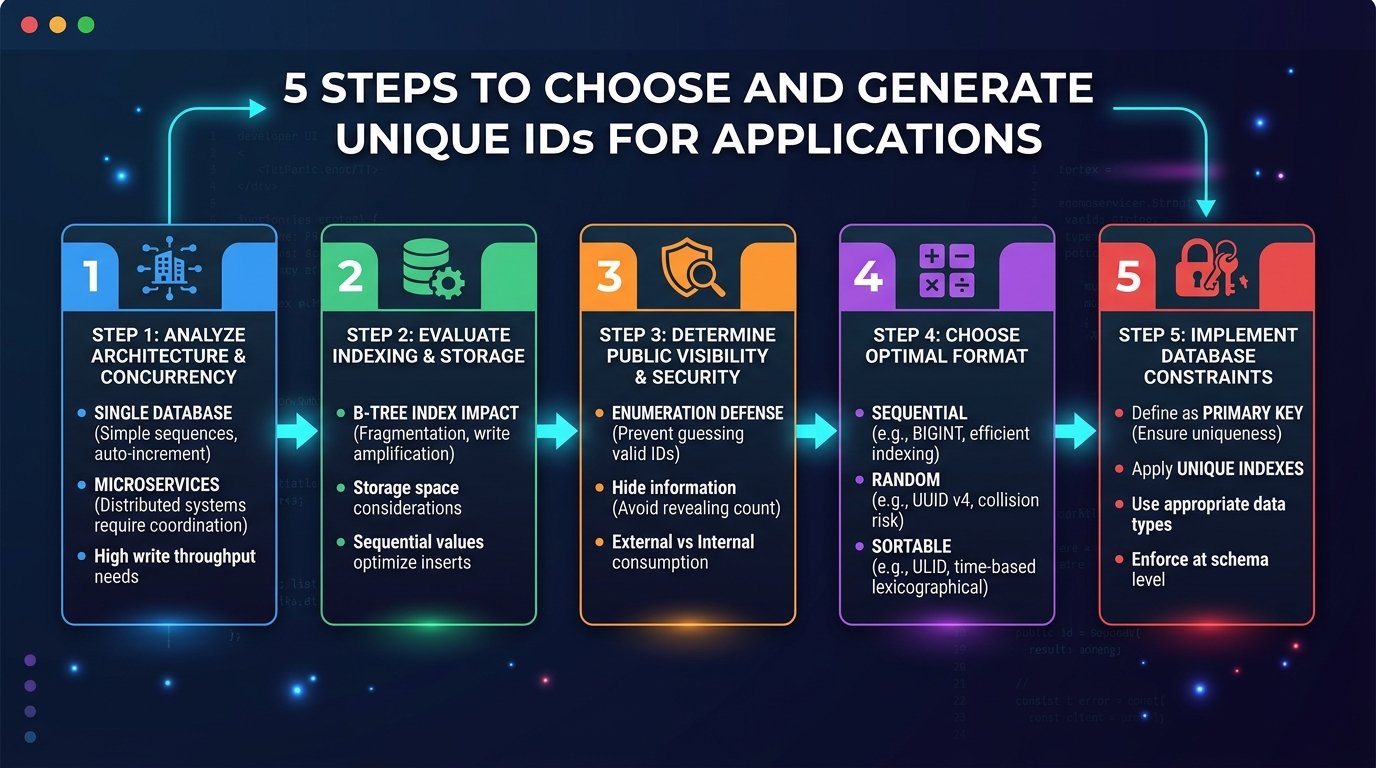
Step 1: Analyze Architecture and Concurrency Requirements
Determine whether records are inserted through a single centralized database node or generated across distributed microservices, edge workers, and offline client devices. If decentralized generation is required, eliminate auto-increment integers immediately.
Step 2: Evaluate Indexing and Storage Constraints
Assess table write volume. For high-throughput tables processing thousands of inserts per second, avoid random UUID v4 clustering. Choose time-ordered UUID v7, ULID, or 64-bit Snowflake IDs to protect B-Tree index performance.
Step 3: Determine Public Visibility and Privacy Boundaries
Identify whether the identifier will be exposed in public REST API URLs, customer invoices, or web links. For public consumption, select opaque UUIDs or custom prefixed tokens (e.g., cus_9a8bc1) to shield internal business metrics from enumeration.
Step 4: Select the Exact Generation Library and Schema Type
Standardize on official cryptographic platform libraries (such as crypto.randomUUID()) rather than ad-hoc random scripts. In database schemas, define columns as native 16-byte UUID types or indexed binary formats.
Step 5: Enforce Database Schema Constraints and Audit Logs
Always enforce explicit PRIMARY KEY or UNIQUE constraints at the database storage layer. Never assume application code alone guarantees uniqueness. Following this five-step process allows engineering teams to generate unique IDs with complete architectural integrity.
Production Checklist to Generate Unique IDs Accurately Across Enterprise Stacks
Before launching new database schemas, API routes, or distributed microservices into production environments, review this comprehensive engineering verification checklist:
- Native Binary Types: Confirm that UUID columns in PostgreSQL or MySQL use native binary or 16-byte storage rather than oversized strings.
- Cryptographic Randomness: Verify that application code calls cryptographically secure entropy functions rather than predictable pseudo-random seeds.
- Index Fragmentation Controls: For high-write transactional tables, verify whether time-ordered UUID v7 or sequential clustering is implemented.
- Authorization Independence: Confirm that API endpoints validate user session authorization and never rely on UUID obscurity as a security barrier.
- Prefix Consistency: If using custom tokens (e.g.,
ord_,usr_), confirm that prefix naming standards are enforced across all services. - Schema Constraints: Ensure database tables enforce hard
PRIMARY KEYconstraints to trap duplicate collisions at the storage layer.
Following these systematic verification steps ensures that every time you generate unique IDs, your distributed services remain robust, performant, and collision-free.
In summary, mastering how to generate unique IDs across applications, APIs, and databases empowers development teams to build highly scalable, distributed architectures. When engineering teams consistently generate unique IDs using standardized cryptographic algorithms, they prevent database collisions, shield critical business intelligence from attackers, and ensure flawless data integrity worldwide.
Frequently Asked Questions About How to Generate Unique IDs
Below are clear, expert answers to the most common questions software engineers, database administrators, and systems architects ask when evaluating identifier strategies.