
Date Difference Calculator – Days Between Two Dates
Find the exact number of days between two dates instantly. Get a full breakdown in days, weeks, months, years, and business days with an include end date option.

Need to find out exactly how many days between two dates? Whether you are monitoring an upcoming project milestone, planning a sprint schedule, computing employee tenure, or determining financial interest intervals, knowing the precise count of days between two dates is an indispensable requirement across modern business operations and software development. Our free online Date Difference Calculator provides an instant, comprehensive breakdown in calendar days, weeks, months, years, and business days without requiring complex spreadsheet macros.
While subtracting one date from another appears intuitive on the surface, date arithmetic is deceptively complex. Human calendars incorporate irregular month lengths ranging from 28 to 31 days, leap years with an extra intercalary day, shifting weekend boundaries, regional public holidays, and daylight saving time adjustments. This technical guide explains the underlying mathematics, provides three detailed worked examples, explores software engineering implementations, and shows you how to calculate the exact days between two dates with total confidence.
Table of Contents
How to Calculate Days Between Two Dates: The Core Formula
At its mathematical foundation, calculating the total days between two dates requires determining the absolute duration separating two points on the calendar timeline. Formally defined under the international ISO 8601 date and time standard, each calendar day is bounded by 24 standard hours consisting of 86,400 SI seconds.
The standard mathematical formula for finding the elapsed duration is expressed as:
Elapsed Days = Serial(End Date) − Serial(Start Date)
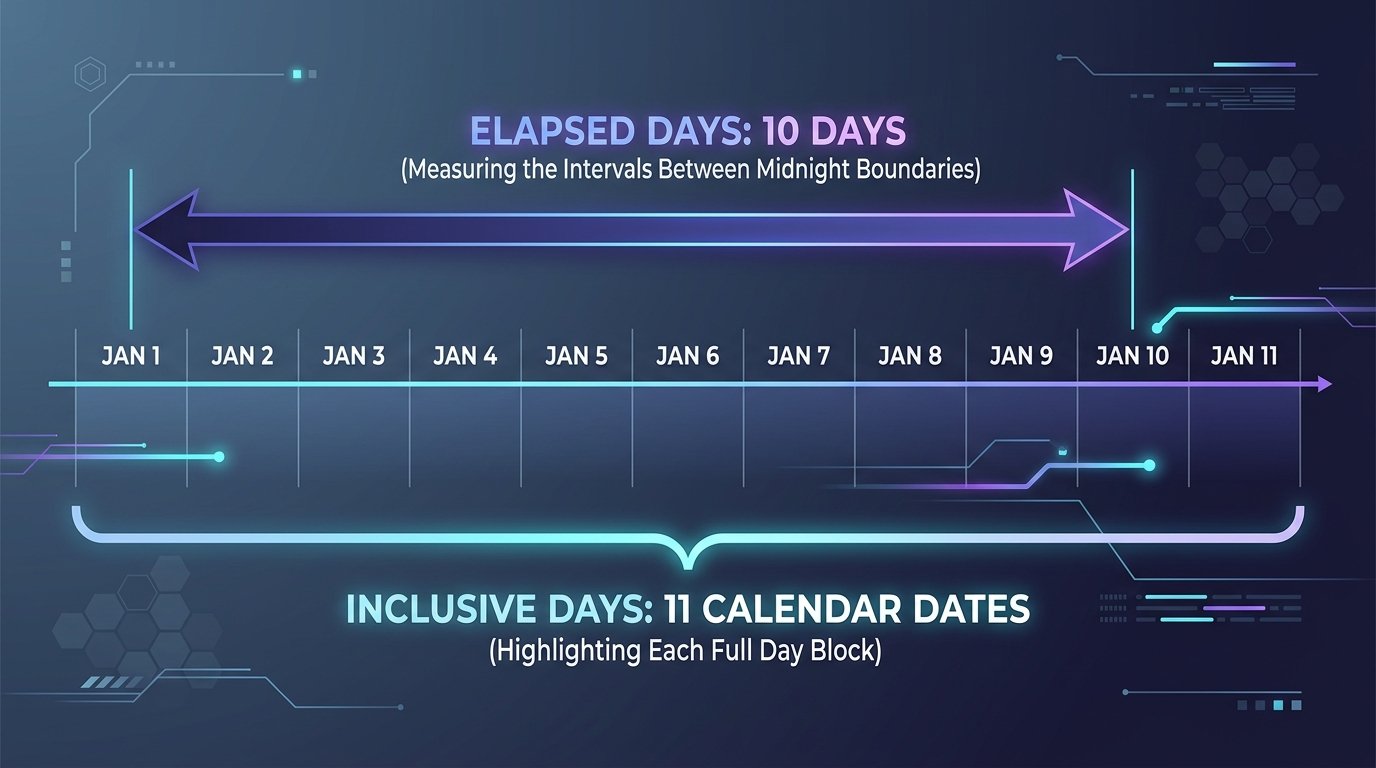
In computing systems, each calendar date is first mapped to a continuous scalar serial number—such as a Julian Day Number (JDN) or a Unix epoch timestamp fixed at 00:00:00 UTC. Subtracting the start serial from the end serial yields the exact integer count of elapsed 24-hour periods. For instance, evaluating the span from January 1, 2026 to January 11, 2026 produces:
- Elapsed (exclusive) days: 10 days — exactly 10 full 24-hour cycles elapse before midnight on January 11.
- Inclusive days: 11 days — every calendar date touched by the timeframe is counted, including both January 1 and January 11.
Choosing between elapsed and inclusive counting represents the single most common cause of off-by-one errors in invoice scheduling, equipment leasing, and contract law. Our free Date Difference Calculator eliminates this ambiguity by allowing users to instantly switch between modes with the dedicated Include End Date checkbox.

Understanding All Outputs: Days, Weeks, Months, Years & Business Days
When users measure the days between two dates, raw calendar days rarely satisfy every analytical purpose. Business managers require working days, sprint leaders plan in weekly blocks, and payroll departments track monthly intervals. A comprehensive calculator converts the base interval into multiple interconnected units simultaneously:
| Output Metric | Calculation Methodology | Optimal Use Case |
|---|---|---|
| Total Calendar Days | Exact 24-hour serial difference (End Date − Start Date) | Daily interest accretion, cloud server uptime SLAs, warranty tracking |
| Weeks and Remaining Days | Total days ÷ 7, formatted as integer weeks and residual days | Agile development sprints, academic term schedules, recurring billing cycles |
| Calendar Months | Calendar-aware stepping from day-of-month to anniversary day | Subscription billing, commercial leases, amortization schedules |
| Calendar Years | Annual anniversary cycles accounting for leap years | Employee service milestones, asset depreciation, age verification |
| Working Business Days | Total days excluding weekend days (Saturdays and Sundays) | Vendor payment terms (Net 30), legal notice periods, freight logistics |
Weeks Calculation Methodology
Converting total days between two dates into weeks utilizes Euclidean division by 7. For example, an interval of 45 calendar days divides into a quotient of 6 and a remainder of 3, yielding 6 weeks and 3 days. Avoid expressing week intervals as raw floating-point fractions such as 6.43 weeks in contractual agreements, because rounding up to 7 weeks artificially expands a contractual delivery deadline by four full days.
Months Calculation Methodology
A frequent mistake in manual date arithmetic is dividing the total days between two dates by an arbitrary average of 30 or 30.4375. Gregorian calendar months vary systematically between 28, 29, 30, and 31 days. A robust algorithm steps forward month-by-month matching the origin day of the month until the next increment exceeds the termination date, then counts residual days. Measuring from March 15 to June 20 represents exactly 3 months and 5 days, rather than an imprecise floating-point estimation.
Years and Age Verification
Multi-year intervals evaluate complete annual anniversary cycles while tracking whether intercalary leap days occur within the evaluated span. For legal age compliance and employment milestones, anniversaries occur on the exact matching calendar day in subsequent years. To perform dedicated chronological age verification, explore our specialized Age Calculator.
The “Include End Date” Option: Elapsed vs Inclusive Counting
The distinction between elapsed and inclusive counting is the primary source of disagreement in date calculations. When finding the days between two dates, understanding when to apply inclusive counting prevents financial discrepancies and scheduling disputes:
- Elapsed Mode (Default / Exclusive): Evaluates the number of full 24-hour periods that have completely passed. In this mode, checking into a facility on Monday morning and checking out on Friday morning equals 4 elapsed days (4 nights).
- Inclusive Mode (Include End Date ON): Counts every calendar date touched by the duration, including both boundaries. That same Monday-to-Friday reservation spans 5 discrete calendar days.
| Practical Application | Recommended Counting Mode | Operational Rationale |
|---|---|---|
| Software project sprint duration | Elapsed Mode | Tracks elapsed development time between start of work and cutoff deadline |
| Hotel reservation and vehicle rental billing | Inclusive Mode | Customer occupies or utilizes capital assets across every calendar day touched |
| Net 30 commercial invoice payment terms | Elapsed Mode | Payment becomes due only after 30 full 24-hour statutory periods elapse |
| Multi-day seminar or conference admission pass | Inclusive Mode | Delegate holds active badge access across all scheduled calendar session dates |
| Statutory notice periods and legal cure intervals | Elapsed Mode | Recipient is legally entitled to complete days of notice before enforcement |
3 Detailed Worked Examples of Days Between Two Dates
To illustrate how these mathematical rules operate in practical business and engineering scenarios, let us examine three detailed real-world worked examples of calculating the days between two dates.
Worked Example 1: Project Delivery Timeline and Working Days
Scenario: An engineering team initiates a high-priority sprint on Monday, October 5, 2026, with a hard production deployment deadline scheduled for Friday, October 23, 2026.
- Total calendar days between two dates (elapsed): 18 days
- Weekly breakdown: 2 full weeks and 4 residual calendar days
- Weekend non-working days: 4 weekend days (October 10–11 and October 17–18)
- Net active business days: 14 working business days
- Include End Date setting: Disabled (elapsed), as work completes upon arrival of the October 23 cutoff.
Key Takeaway: While the calendar suggests nearly three full weeks, the engineering team possesses only 14 productive business days. Failure to isolate business days leads directly to missed software delivery milestones.
Worked Example 2: Commercial Real Estate Lease Duration
Scenario: A business enterprise executes an office lease commencing on February 1, 2026 and terminating on July 31, 2026.
- Elapsed days between two dates: 180 days
- Inclusive days (Include End Date ON): 181 days (tenant retains legal occupancy through midnight on July 31)
- Calendar months: Exactly 6 complete calendar months (February through July)
- Annual duration: 0 years, 6 months, and 0 residual days
Key Takeaway: For property management and per-diem asset billing, inclusive counting is mandatory. The organization occupies the space for 181 distinct calendar days. For related financial analysis, consult our guide on the ROI Formula and Practical Examples.
Worked Example 3: Enterprise Warranty Spanning an Intercalary Leap Year
Scenario: Data center hardware is acquired on January 15, 2024 with an extended 24-month hardware warranty expiring on January 15, 2026.
- Total days between two dates: 731 calendar days (rather than 730 days)
- Weekly breakdown: 104 full weeks and 3 extra days
- Leap year impact: Year 2024 was an intercalary leap year containing February 29, 2024, adding one full day.
- Working business days: 523 working days
Key Takeaway: Because the evaluated timeframe crossed February 29, the contract spans 731 elapsed days. If a hardware failure occurs on the 731st day, automated systems must honor warranty claims. Precise date math prevents premature contract invalidation. For financial break-even modeling across operational lifecycles, review our Break-Even Calculator guide.
How Leap Years and Calendar Rules Affect Days Between Two Dates
The modern Gregorian calendar harmonizes civil timekeeping with astronomical solar realities. Because Earth requires approximately 365.2422 mean solar days to complete one orbital revolution around the sun, an unadjusted 365-day calendar drifts by approximately 24 days per century. Under the Gregorian reform, intercalary leap days are governed by three precise mathematical criteria:
- The calendar year must be evenly divisible by 4;
- If the year is divisible by 100, it is NOT a leap year;
- Unless the year is also evenly divisible by 400, in which case it IS a leap year.
Consequently, years 2000 and 2024 were leap years with 366 days, whereas year 2100 will have only 365 days. When calculating the days between two dates across multi-year contracts or long-term financial debentures, failing to test for leap years introduces cumulative multi-day inaccuracies into financial reporting models.
How to Calculate Business Days Between Two Dates Accurately
Corporate operations rely on business days for service level agreements (SLAs), treasury settlement windows, and supply chain commitments. The algorithm to isolate business days between two dates follows a structured computational pipeline:
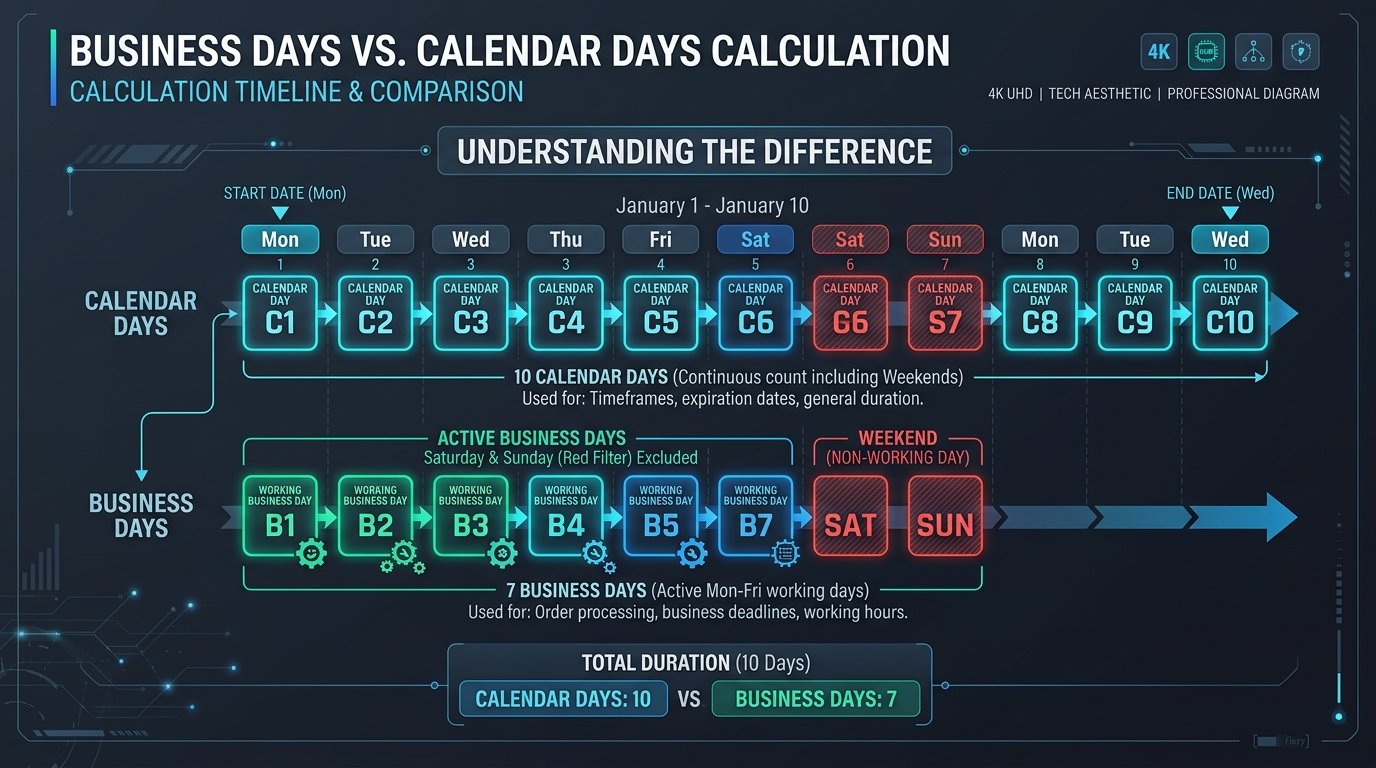
The step-by-step mathematical procedure proceeds as follows:
- Compute total elapsed days: Find the baseline calendar distance between the start and end dates.
- Isolate complete weeks: Determine complete 7-day cycles (
Full Weeks = Total Days ÷ 7). Each complete week contributes exactly 5 working business days. - Evaluate residual days: For remaining days, inspect the day-of-week index (Sunday through Saturday) and accumulate only days corresponding to Monday through Friday.
- Deduct statutory holidays: Subtract non-working public holidays falling on weekdays within the target window.
In global financial markets, international day-count conventions determine how interest accrues when measuring days between two dates:
| Convention Standard | Numerator (Days Measured) | Denominator (Year Base) | Primary Financial Market |
|---|---|---|---|
| Actual / Actual (ICMA) | Exact calendar days elapsed | Exact days in evaluated year (365 or 366) | Government bonds and sovereign treasury debt |
| Actual / 360 | Exact calendar days elapsed | Fixed financial year of 360 days | Money market instruments, commercial paper, SOFR lending |
| Actual / 365 Fixed | Exact calendar days elapsed | Fixed financial year of 365 days | Sterling markets and British Commonwealth debentures |
| 30 / 360 (Bond Basis) | Assumes 30 days per month | Fixed financial year of 360 days | Corporate bonds and agency mortgage-backed securities |
For purchasing, merchandising, and pricing markups, see our companion guide on the Reverse Discount Calculator for practical applications of commercial arithmetic.
Software Engineering: Calculating Days Between Two Dates in Code
Software engineers frequently need to calculate the days between two dates programmatically. Different programming languages and runtime engines provide native APIs to execute this operation:

According to official developer documentation on the MDN Web Docs Date specification, JavaScript dates store millisecond offsets relative to January 1, 1970 00:00:00 UTC. The standard implementation pattern across major technologies includes:
| Technology Stack | Canonical Code Pattern | Key Engineering Consideration |
|---|---|---|
| JavaScript / TypeScript | Math.floor((d2 - d1) / (1000 * 60 * 60 * 24)) |
Always normalize timestamps to UTC midnight (00:00:00Z) to prevent daylight saving off-by-one errors |
| Python (datetime) | (date2 - date1).days |
Subtracting date objects yields a timedelta whose .days attribute directly reports integer days |
| SQL (PostgreSQL / MySQL) | DATEDIFF(end_date, start_date) |
PostgreSQL supports direct subtraction (date2 - date1), returning an integer day value |
| Microsoft Excel / Google Sheets | =DATEDIF(start_date, end_date, "D") |
Direct cell subtraction =B1 - A1 also returns the exact calendar day interval |
When dealing with distributed microservices or machine timestamps across server clusters, converting timestamps through our Unix Timestamp Converter guarantees absolute UTC consistency without local server clock skew.
Daylight Saving Time and Timezone Anomalies in Date Arithmetic
One of the most treacherous edge cases in computing the days between two dates involves Daylight Saving Time (DST) transitions. On the day a regional clock springs forward, that calendar day spans only 23 astronomical hours. Conversely, when clocks fall back in autumn, the day contains 25 hours.
If software computes duration by dividing raw local timestamps by 86,400,000 milliseconds, an interval crossing a spring-forward transition produces 0.9583 days, which Math.floor() mistakenly rounds down to 0 days. To eliminate daylight saving anomalies when finding the days between two dates, always convert timestamps to UTC midnight prior to executing serial subtraction.
Related Date and Time Calculation Tools on EzzDo
Beyond calculating the interval separating two dates, EzzDo provides a complete suite of high-performance online utilities designed to streamline your daily workflow:
- 🗓 Date Difference Calculator — our flagship interactive calculator featuring instant unit breakdowns and inclusive counting toggles.
- 🎂 Age Calculator — determines precise chronological age in years, months, and days from date of birth.
- ⏱ Unix Timestamp Converter — seamlessly convert between human-readable calendar dates and 10-digit/13-digit Unix epoch timestamps.
- 📖 Reading Time Calculator — estimate reading and speaking durations for technical articles and editorial copy.
- 💰 ROI Formula Guide — calculate annualized return on investment across specific investment holding periods.
- 📊 Break-Even Calculator Guide — compute required sales volume and revenue targets across project timelines.
- 🏷 Reverse Discount Calculator — determine pre-discount list prices and promotional markdowns.
Frequently Asked Questions About Calculating Days Between Two Dates
Summary: Checklist for Finding Days Between Two Dates
Accurately calculating the days between two dates requires careful attention to counting conventions and calendar mechanics. Follow this quick five-point verification checklist whenever calculating calendar intervals:
- Define the counting boundary: Determine whether your application requires exclusive elapsed time (e.g. project durations) or inclusive calendar counting (e.g. property leases).
- Filter weekend non-working days: When evaluating commercial SLAs or delivery timelines, convert total days between two dates into working business days.
- Verify leap year presence: Check whether your timeframe crosses February 29 in an intercalary year such as 2024 or 2028.
- Normalize to UTC midnight: In programmatic software systems, eliminate daylight saving time shifts by converting local calendar dates to UTC before performing arithmetic subtraction.
- Express residual units cleanly: When converting to weeks or months, preserve the exact integer remainder in days rather than relying on misleading decimal fractions.
Try our free online Date Difference Calculator right now to calculate the exact days between two dates in seconds!